Jennifer Higgie on constructive messiness
Just over one hundred years ago, when the world was busy blowing itself up during World War I, a protest movement was born in Switzerland. In a small room in a nightclub in Zurich (the short lived Cabaret Voltaire), Dada burst into life with poetry, puppets, paintings, performances and music – a form of absurdist revelry with deeply serious intentions. As one of Dada’s founders, Hugo Ball, wrote in his diary in 1916: “Our cabaret is a gesture. Every word that is spoken and sung here says at least this one thing: that this humiliating age has not succeeded in winning our respect.” Dada’s many members, if you can call them that (they would have been the first to condemn the idea of membership) were arguing for a language – be it written, visual, aural or performed – that represented an actual, as opposed to an ideal, version of life, one that responded with a wild imaginative howl to the government-sanctioned carnage that resulted in the deaths of around 38 million people. (As I write, in 2017, we only need to witness the plight of 63 million people displaced across the world due to war and conflict to see what the Dadaists were getting at. Plus ça change.) As Tristan Tzara wrote in his manifesto of 1918, Dada wanted to embrace the “abolition of logic, which is the dance of those impotent to create […] Freedom: Dada Dada Dada, a roaring of tense colours, and interlacing of opposites and of all contradictions, grotesques, inconsistencies: LIFE.”
This essay was originally written for Molonglo by Jennifer Higgie in 2017.
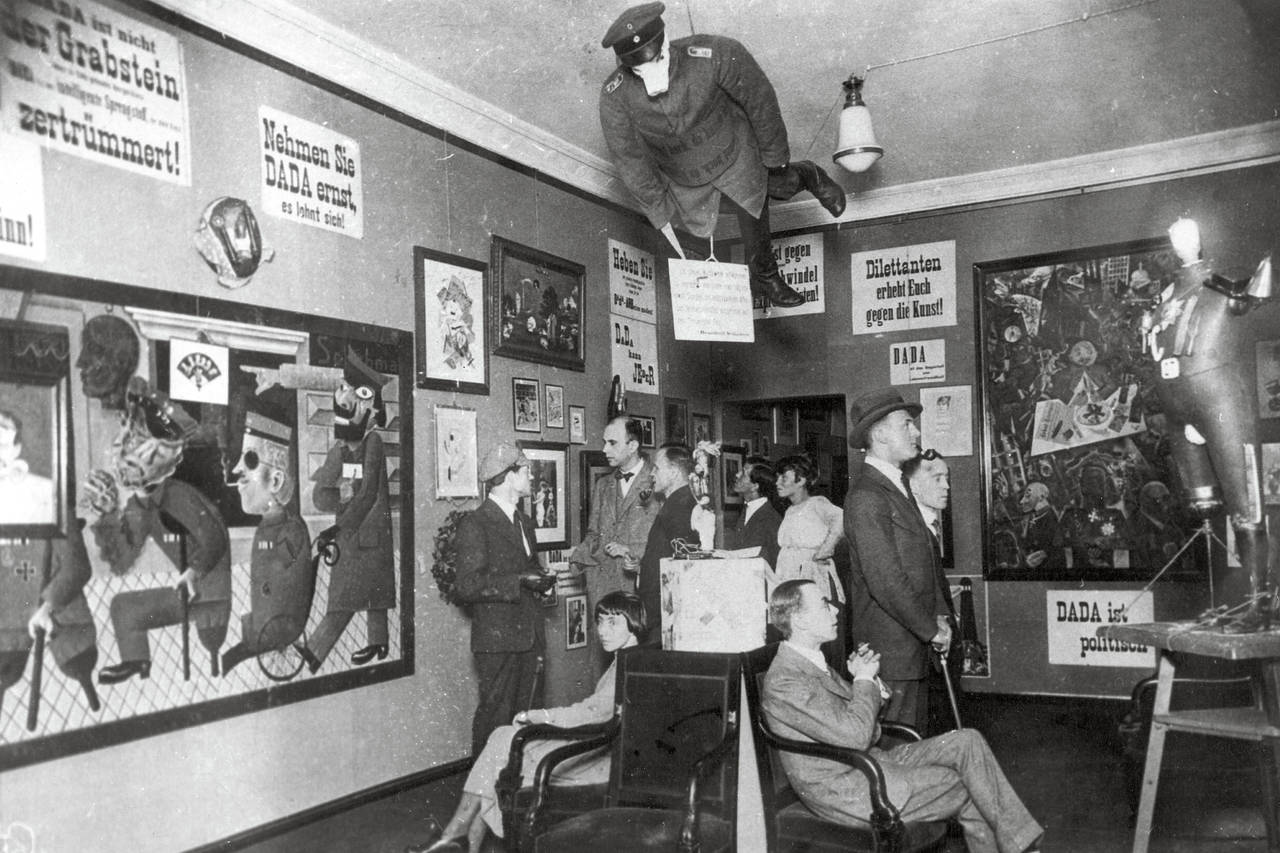
Image: The opening of the first ‘International Dada Fair’ in the bookstore of Dr. Burchard, Berlin, 1920. Courtesy: Bildagentur für Kunst, Kultur und Geschichte, Berlin, and Scala, Florence.
Dada was to become one of the most influential art movements of the past century. Its central radical gesture was to give permission to artists to express themselves however they saw fit, however outlandish that self might be, in response to whatever urgent situation they found themselves in. If life is irrational and unreasonable, they asked, why should art be any different?
When this brilliant, angry group of friends in Zurich decided to shake up the status quo and make a right old mess of things, they made the world an infinitely more interesting place. A central tenet of their approach was collage, both as a technique and a metaphor for the intermingling of life and art. Initially explored by Pablo Picasso and George Braque in Paris in 1912, it involved creating images from newspaper clippings and fashion magazines, railway tickets, menus, maps and sweet wrappers: traditional hierarchies of high and low art were thrown out of the window and into oblivion. Early modernist collage cleared the way for artists and designers to extend these ideas into different media and to various ends. From Hannah Hoch’s caustic, brilliant photomontages, which entwined politics and feminism, to Marcel Duchamp’s ‘readymades’, John Cage’s ‘chance operations’, Mike Kelley’s caustic cabarets and Kara Walker’s blistering employment of caricature, to a new generation of contemporary artists such as Helen Johnson, Helen Marten, Ed Atkins and Martine Syms, collage infiltrated painting, sculpture, video, online worlds and beyond. Like the Dadaists, contemporary collectives such as Assemble, Slavs and Tatars (who describe themselves as ‘archaeologists of the everyday’) and Superflex have resisted being too pigeon-holed in order to experiment with mixing elements of art, design, architecture and daily life in order to respond to pressing social, cultural and political issues – between them, they’ve designed alternative living structures, radical parks and playgrounds, created a cinema from a petrol station, initiated publishing ventures and designed drinks. Their various unorthodox approaches to problem-solving are now very much part of the mainstream: Assemble won the Turner Prize in 2015 and the 2017 Hyundai Commission for Tate Modern’s Turbine Hall will be undertaken by Superflex.*
*Editor’s note – It was. Superflex’s One Two Three Swing! consisted of a series of swings, aimed at challenging society’s apathy in the face of the increasingly urgent climate crisis. At once a playful collective action, a commentary on the capacity for social movement to create energy, and a thoughtful perspective on the use of public space in urban settings.
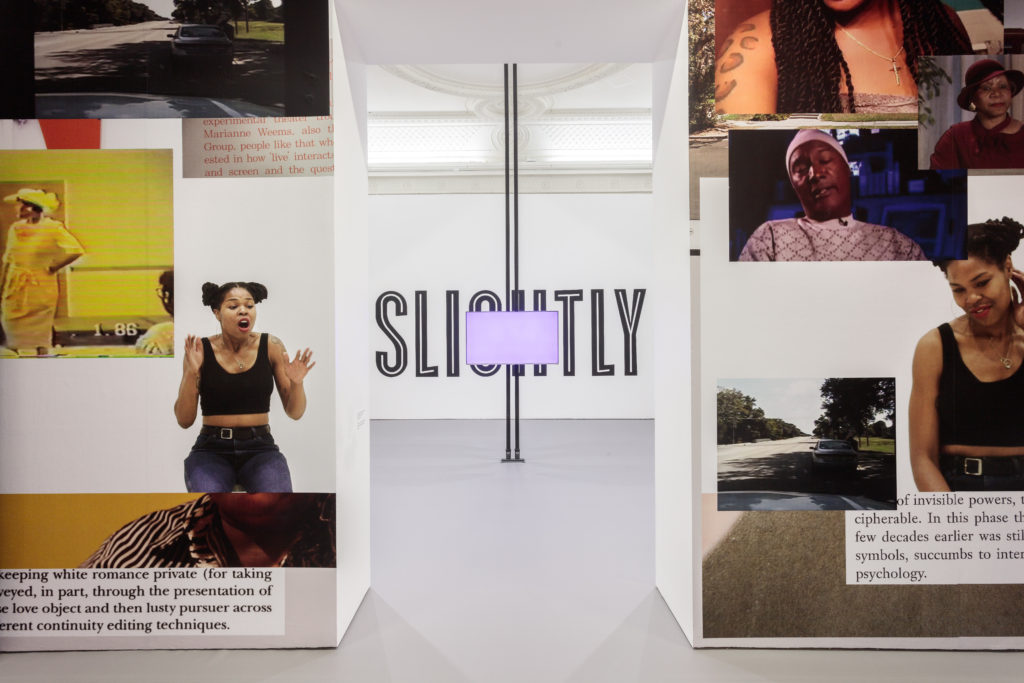
Image: Martine Syms, 'Fact & Trouble', 2016. Installation view. Photo: Mark Blower. Courtesy of ICA, London.
‘Messy’ is a loaded, culturally-determined word. Walk down any street and it will soon become obvious that one person’s mess is another’s idea of beauty. Most of us were berated from an early age to tidy our rooms, our ambitions, our appearances, our thinking. The dictionary tells us that ‘messy’ means untidy or dirty, or describes a situation that is ‘confused and difficult to deal with’. Messy is often understood to be the opposite of efficiency – something that hinders rather than helps – yet countless studies have proven that a messy desk, for example, can reflect a productive, original mind. For their book, Cognitive Architecture: Designing for How We Respond to the Built Environment (2014) Justin Hollander (an urban policy professor) and architect Ann Sussman studied scientific data in order to better understand what makes people happy in cities. Most humans, they argue, function best in intimate environments and crave variety; they also discovered that being bored by a street increases your heart rate and cortisol level more dramatically than sadness does. Writing about the book in the New York Times last year, and discussing the gentrification of downtown New York, Jacoba Urist concluded that: “The Whole Foods may have gentrified the neighbourhood with more high-quality organic groceries, but the building itself stifled people. Its architecture blah-ness made their minds and bodies go meh.”
‘Messy’ is a word that is usually used in a derogatory way to describe something made by humans. We regard nature – which is innately messy – in its wild state as beautiful; obviously there’s no such thing as a tidy ocean, mountain or forest. But of course nature’s messiness might seem chaotic or random but it’s anything but: it’s adaptable. As a child, I was astonished to learn about some Australian plants that need to burn every few years in order to regenerate: I couldn’t imagine turning something as terrifying as a bushfire into something so productive. The best ideas are usually the most adaptable ones – the ones that, like plants embracing catastrophe, respond ingeniously and constructively to social change and need. Perhaps counter-intuitively, it’s often a lack of comfort and consensus that moves an idea in unexpected directions and allows it to flourish. Messiness is both a challenge to convention and a reflection of what it is to be human: has anyone ever lived a truly tidy life? How could we, on such a messy planet? And why should we?
Accommodating a certain level of messiness as a natural state is a way of accepting the reality of being alive. It also makes for good art. The young British artist Samara Scott recycles the detritus of everyday life in order to make her often perishable sculptures: her exhibition ‘Silks’, at Birmingham’s Eastside Projects in 2015, listed 143 components, including nail polish, a cistern block capsule, an Innocent smoothie bottle and glitter toothpaste. In a subsequent interview she said: “A lot of the things I use are items we are encouraged to lather on ourselves, or ingest, that we believe might transform us. [… ] I feel I can only express concerns or anxieties or paranoia through materials. I can’t be genuine by drawing or painting images … for me, a hair bobble or a green bean can be a really useful stroke.”
Similarly, the French artist Camille Henrot also uses (often online) material from the world around her. She says that her loosely anthropological approach to art-making
contains interpretive mistakes and naïveties, as well as irregularities in terms of the fundamentals of this art. The presence of such errors is, however, perfectly integrated into my approach. […] I am consistently more interested in the errors and unsolved problems of anthropology, being a science that takes we humans as both object and subject and our universe and world as both substance and projected meaning at the same time and, like art, continually critiques, overturns and transforms its own findings.
To my mind, Henrot’s work is utterly hypnotising because it asks often open-ended questions in such a visually complex way that your thinking veers into unexplored territory. You never know what’s coming next – and that is exhilarating. As Dan Fox has written:
The “whole” of Henrot’s work is a project about the impossibility of ever knowing the whole – the whole universe, the whole story, the whole of you, me, us and them. It’s about the impossibility of plugging the hole in the doughnut. Her project is shaped by alterity, entranced by cultural disconnections and a little gleeful about the shortcomings of anthropology.
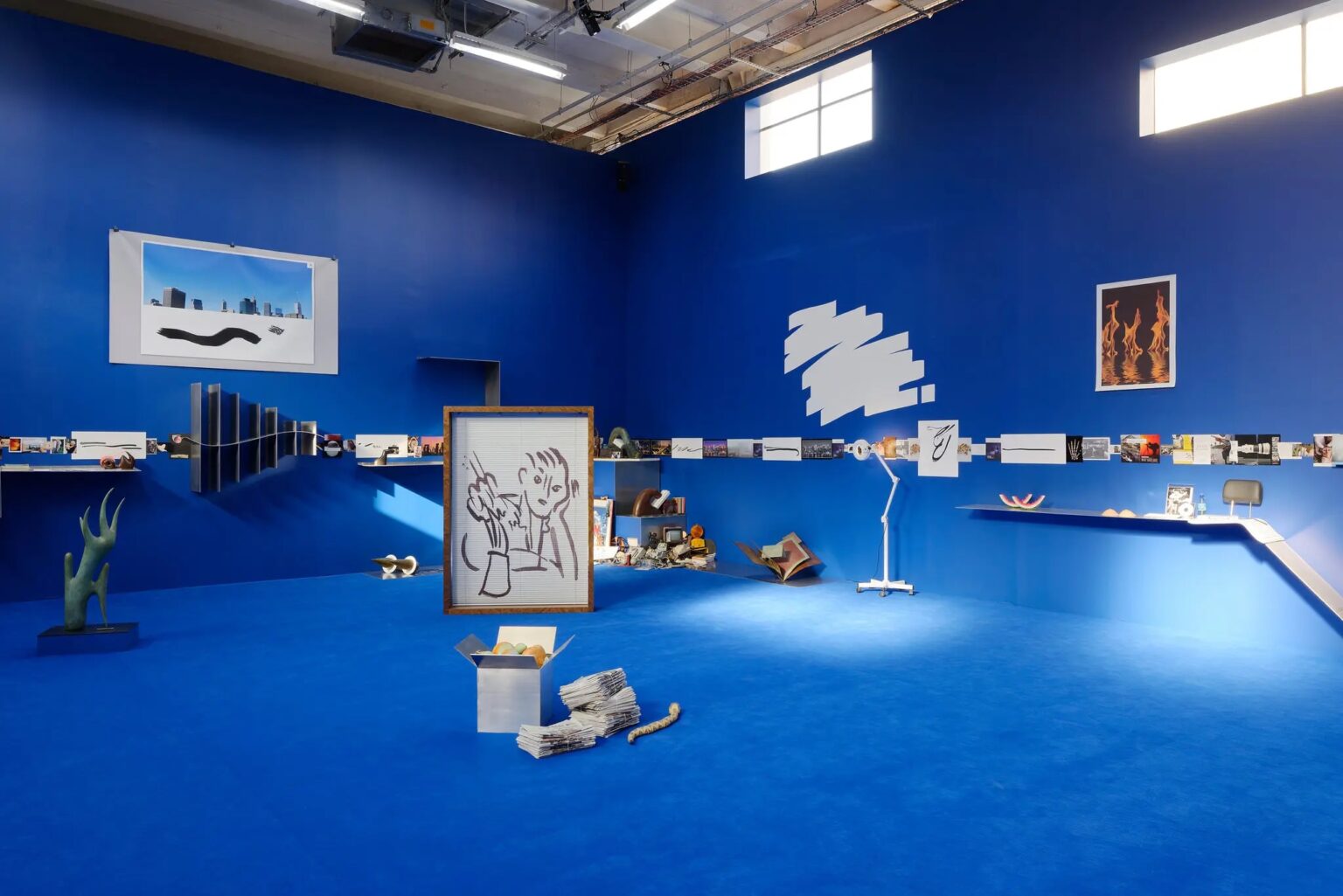
Image: Camille Henrot, ‘The Pale Fox’(detail), 2017 in ‘Days Are Dogs’ at Palais de Tokyo, Paris. Photo: 2017 Artists Rights Society (ARS), New York/ADAGP, Paris/Aurélien Mole. Courtesy of Palais de Tokyo.
The frightening range of social, political, economic and environmental crises the planet currently faces require innovative solutions – but they have to be imagined first. In recent decades, myriad artists from various disciplines have come up with inspired answers to the question of how to effect change and respond to the demanding needs of particular communities. In order to highlight the potential of derelict spaces, in 1970 the San Franciscan artist Bonnie Ora Sherk – who from the get-go has liked to jolt people out of complacent thinking using a mix of absurdity, visual poetry and pragmatism – dressed in an evening gown, waded through a deep pool of rancid water to an abandoned chair and sat in it, facing an audience of startled people in passing cars. This was the beginning of her series ‘Sitting Still’, which culminated in her having lunch with animals in a cage in the San Francisco Zoo. In 1974, Sherk was the driving force behind the Crossroads Community, also known as The Farm, in San Francisco. Along with a group of artists and local community activists, she helped transform seven acres of wasteland under a highway overpass into a children’s farm, a theatre and a rehearsal space, “a ‘school without walls’, a library, a darkroom and gardens ‘for humans and other animals’.”(I assume Assemble were aware of Sherk’s work when, using reclaimed or donated materials, they transformed a disused motorway flyover in London’s Hackney Wick into an arts venue for six weeks in 2011.) In 2017, Sherk’s work was included in ‘Viva Arte Viva’ at the Venice Biennale. In an accompanying film portrait of the artist she declares that: “the ultimate performance is being a total human being”. She now runs Life Frames Inc., a non-profit foundation which is the sponsor of the Living Library, a mobile framework that helps develop methodologies for creating “place-based, ecological change in communities and schools”.
Messy thinking is a form of resistance to tired ways of doing things. A few years ago, I met the inspirational Slovenian artist Marjetica Potrč: after originally training as an architect, she now describes herself as someone who “builds stories with architectural materials”. While she still stages exhibitions in galleries – spaces she sees as laboratories for change – much of her work takes her into under-resourced communities in order to arrive at solutions to local problems, many of which have been caused by the worst manifestations of globalism and postcolonialism. Her approach is to live alongside people and to talk to them in order to experience first hand what it is they might need in order to improve the quality of their lives. Like an extension of Duchamp’s urinal into social practice, one of Potrč’s best-known projects is ‘Caracas: Dry Toilet’ (2003–4), which evolved from a six-month stay in a slum in Venezuela during which the artist – in collaboration with Israeli architect Liyat Esakov and the local neighbourhood association – designed an environmentally friendly toilet that collects waste and turns it into fertiliser for an area with no running water. Other projects have included building – alongside students from the course she teaches at the University of Fine Arts HFBK in Hamburg, Design for the Living World – a community park in a former wasteland in Soweto (‘The Soweto Project’, 2015) and designing UK’s first ever, man-made natural swimming pond in a high-density area of central London (‘Of Soil and Water: The King’s Cross Pond Club’ 2015-16). Potrč feels deeply that engaging communities in sustainable problem-solving serves to instil an understanding of democratic processes into often disenfranchised areas. As she put it: “One could say that the empowerment of individuals through architecture is political, and this is true – design and aesthetics, after all, have never been neutral. But this misses the main point. For it is simply a question of human dignity to be able to build your home the way you envision it.” Potrč’s success in engaging with local communities is echoed in a recent piece written for frieze by the design historian and critic, Alice Rawsthorn. She writes that:
Tellingly, many of the most successful projects operating in developing countries are the work of local designers. Wecyclers was co-founded in 2012 by the Nigerian design entrepreneur Bilikiss Adebiyi-Abiola to clear recyclable waste from the Lagos slums, using cargo bikes specially devised to navigate the congested streets. In Uganda, Eco-Fuel Africa has established a network of 3,500 farmers, who convert their agricultural waste into clean, inexpensive cooking fuel to be sold to people living in deforested, rural areas, such as the village where its co-founder Sanga Moses grew up.
Potrč is just one of many socially-engaged artists around the world whose work employs an idiosyncratic mix of art, design, architecture, environmentalism and politics – a kind of cultural collage, if you will. Hers is a practice that sees the creation of boundaries as a limiting one. Similarly, the US artist Andrea Zittel has spent years on her ‘A-Z enterprise’ (1991 — ongoing), which she describes as encompassing ‘all aspects of day-to-day living’. For it, she has designed micro-living units, rugs, cooking utensils and clothes in order, she states on her website, to “endeavour to better understand human nature and the social construction of needs”. The Iraqi/US artist Michael Rakowitz has also manifested creative solutions to urban problems. In 1998, for example, distressed by the plight of people sleeping rough, he initiated paraSITE, an ongoing project for which he designed 30 cheap inflatable shelters that attach to the exterior vents of a building’s heating, ventilation, or air conditioning system, which in turn inflate and heats the dwelling. Each ‘tent’ was customised to the demands of the person who was to sleep in it. For example, one man, Freddie F, described as ‘an avid science fiction fan’, requested (and received) a shelter in the shape of Jabba the Hutt. Rakowitz’s project Enemy Kitchen (2003-ongoing) employs veterans of the Iraq War to work under Iraqi refugee chefs who supply food to Chicago’s hungry public. Rakowitz also teaches cooking himself. He says: “With the help of my Iraqi-Jewish mother, I have compiled Baghdadi recipes to teach to different public audiences, including middle and high school students. Preparing and then consuming this food opens up a new route through which Iraq can be discussed – in this case, through that most familiar of cultural staples: nourishment.” In 2018, his sculpture for London’s Fourth Plinth in Trafalgar Square will be unveiled. A response to the cultural devastation raging in Syria and Iraq, titled The Invisible Enemy Should Not Exist, it will be a large recreation, built from empty date syrup cans, of Lamassu, an ancient Assyrian winged bull from Nineveh, Iraq from 700BC that was destroyed by Daesh in 2015. About the sculpture, Rakowitz has said: “I see this work as a ghost of the original, and as a placeholder for those human lives that cannot be reconstructed, that are still searching for sanctuary.”
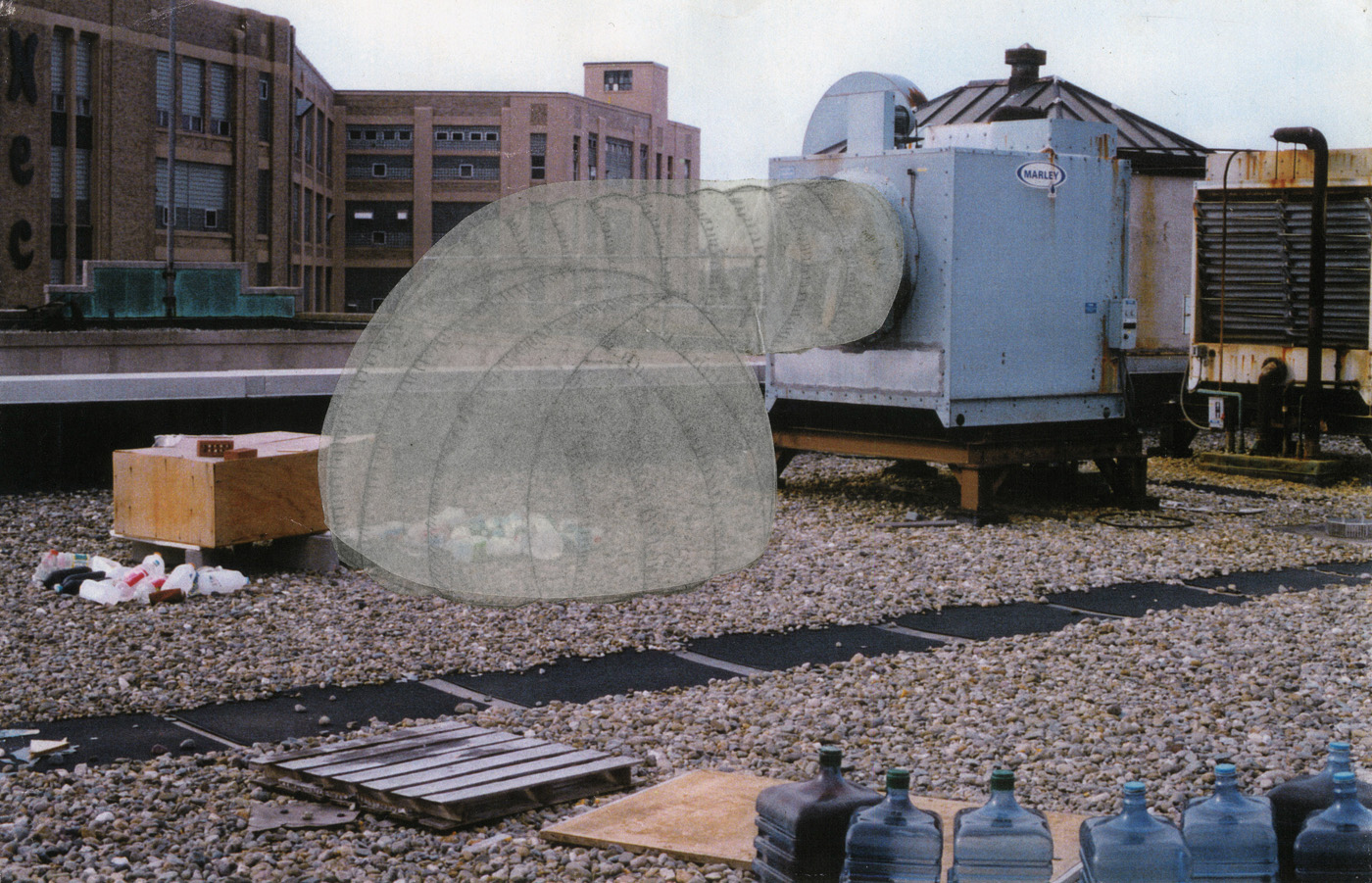
Image: Michael Rakowitz, drawing of the ParaSITE shelter, 1998 - ongoing. Sourced from the artist's website.
In 2016, in collaboration with Thyssen-Bornemisza Art Contemporary, Vienna (TBA21), the Danish-Icelandic artist Olafur Eliasson launched ‘Green light: An Artistic Workshop’. The project evolved out of the refugee crisis: for periods of around eight weeks, the artist invited 40 refugees and asylum seekers to build the Green Light lamps that he designed. Participants learnt skills and took part in workshops around “migration, citizenship, statelessness, arrival, memory, and belonging” in order to “generate an exchange of knowledge, experiences, and values”. Eliasson is deeply invested in the idea of using contemporary art to examine processes of civic change and to experiment with alternative forms of community. In 2012, in collaboration with the engineer Frederick Ottesen, Eliasson designed Little Sun – a solar-powered lamp that is sold at higher prices in areas with electricity in order to fund lamps for the 1.1 billion people worldwide who have no access to electricity. Eliasson describes Little Sun as a ‘global project and a social business’. I suspect the question of whether it’s an artwork or simply a functional lamp is a question rendered irrelevant by the urgency of the need that has created it: would a young person unable to study at night because of a lack of light really care how the person who had given him or her a lamp defined themselves?
These are just a few examples of artists working around ideas of social responsibility, but what makes them all stand out is the unpredictability – the constructive messiness, if you will – of their various approaches. Art is often assumed to be a lonely endeavour, but Eliasson, Potrč, Rakowitz and Sherk and others all work with communities in the most imaginative ways possible in order to not only improve lives but to also to expand the idea of what art itself is and can be.