In this essay Nadine Monem positions walking as a subversive act useful to the design process
The history of walking in the city is a story of resistance and surrender, of thinking and making, of naming and being. Walking in a city, whether new or familiar, encourages slowness. It binds the experience of one place to another in the continuous ‘here’ of the walker, and it binds the (sometimes long) history of the material landscape to the character and concerns of the present moment. Walking is often improvisatory, full of accident, diversion and surprise, but whatever else it is, walking is always situated, and always particular. To really know a city, it isn’t enough to know the buildings, roads and interiors that make up its structural landscape, the character of the city really expresses itself in the meaning and relation created within and between architectural structures, and that meaning is best understood through the rhythms of the body, through the one-two of being with the city.
Walking is not only a means to understand the city, or a way to traverse it, walking is also sometimes a means to know the self, or a mode of creative work. Who could forget the flâneur, first described by Baudelaire, resisting the demands of modern life and ambling through the city on his way to nowhere in particular? Walking is also sometimes a spiritual act, taking the form of a pilgrimage or a vigil, and when people walk together in public under a common aim, that walking sometimes takes the form of a mass act of resistance, a political act carried out in the public realm. So powerful is the subversive act of walking together, so central to citizenship and democracy, that the right to be outside, or congregate in groups, is often the first thing revoked in times of serious political rupture or under repressive government (Solnit, 2014). Importantly, sometimes walking is nothing at all — a simple, near-unconscious movement so essential to humanness that it sometimes stands in for a definition of what it means to be human in the first place.
Of course, it is important to acknowledge that there are conditions for unimpeded walking not available to everyone for reasons of physical ability or political freedom. The movement of differently abled people is often overlooked in cultural accounts of walking in the city. Walking as understood here — as a slow and situated observational, creative, critical, relational or automatic act — can be just as wholly accomplished in the roll of a wheelchair as in the movement of two feet. Whether, or not the city is designed and maintained according to the needs of people of all abilities is another matter. If another pre-condition to walking in the city is freedom to walk without constraint, we need to think critically about how power relations play out in public space. Throughout the history of the city, and all over the world, women have been prevented from walking freely — their presence in the street made morally or legally suspect, often with the perceived or real threat of physical violence. Rebecca Solnit, in her Wanderlust (2014), reminds us that there were no flânuese, the idea that women could comfortably and safely amble the city in observation and contemplation was fundamentally at odds with their political status and social function. Keeping women confined to interior space is a way to prevent them from participating in public life, it is an expression of political and social domination and a denial of liberty — the effect is the same whether this confinement is enforced through legal structures or social ones. In the same way, people of colour — whether born to the city, newly-arrived, or part of subaltern groups whose ancestral homes have been displaced by the colonial forces that built the city in the first place — have also been restricted from fully participating in public life, their presence in public criminalised, or met with harassment and obstruction in what amounts to a denial of basic freedom. These racial restrictions were often enshrined in laws now revised, but they persist in practices such as ‘stop and search’, which find their expression in almost every colonial place and are disproportionately applied to people of colour, often with tragic consequences. As Solnit writes, ‘If walking is a primary cultural act and a crucial way of being in the world, those who have been unable to walk out as far as their feet would take them have been denied not merely exercise or recreation but a vast portion of their humanity’ (Solnit, 2014). So, in thinking about the subversive act of walking, it is crucial to keep in mind that, for many people, moving through the city is always already subversive simply because of their embodied experience of physical and political space.
Even for those for whom there are no such barriers to walking in the city, it is becoming more difficult. New cities are often designed in sprawl, and we are encouraged to move in chopped up time through a series of unwalkable interiors — from the inside of buildings, to the inside of cars, to the enclosed space of parking garages, to the interiors of other buildings. What is lost in cities that are less and less walkable? Or put another way, why is a walkable city a good city? The quality of ‘walkability’ is hard to quantify, and has no single accepted definition, but in its broadest terms and by almost every metric, walkable cities are healthier than sprawling ones. However banal an observation, walking keeps inhabitants active, in a counter to the serious and growing worldwide problem of obesity — the rate of which has tripled since 1975 according the WHO. Cities that prioritise people over cars have fewer road journeys, which diminishes the threat to life from road accidents, a leading cause of child and adolescent death worldwide. The features that make a city walkable also tend to make them good to live in, and attractive to a significant and growing pro-urban, car-agnostic population. Jeff Speck, in his The Walkable City (2012), writes that demographic shifts mean ‘pro-urban segments of the population are becoming dominant, creating a spike in demand that is expected to last for decades’ and that this demographic vastly favours walkable cities over sprawling ones. Places designed with walking in mind attract more residents, boosting residential and retail property values, significantly increasing walk-up trade in the local area, and potentially making these places more prosperous overall (Speck, 2012). There are economic benefits at city and national level too, fewer road journeys means considerable savings in infrastructure, congestion, and environmental costs, and a more active population reduces spending pressure on health and social services. Walkable cities are not only healthier for the people who live in them, and healthier for the local and civic economy, they are better for our urgently ailing planet. If carbon emissions are best measured per person rather than by geographical region, the densely populated city turns out to be the lowest carbon-emitting built framework by a large margin (Speck, 2012). There are less (though not un-) quantifiable reasons why the walkable city is a good city, and that is the connections that come from unplanned interactions between people in the street, in the parks, in the cafes and grocers. These interactions counter feelings of isolation and anxiety, they provide opportunities for inter-generational, cross-cultural and intersectional exchange, and they are difficult to otherwise manufacture. Such accidents of connection and relation only come from sharing the intimacy of public space, from the everyday contact that eventually accrues to community.
If walkable cities are healthier, more sustainable, better to live in, and potentially more prosperous — if walkable cities are good cities — how can we design cities that people want to walk in? Different theories and strategies abound, but there are common propositions. Central among them is designing for the perceived and real safety of pedestrians from crime and road traffic. With the prevention of street crime at issue, Francesco Careri is one of many voices that extol the virtues of passive surveillance, writing in his Walkscapes (2012) that ‘the only way to have a safe city is to have people walking the street. This factor alone allows people to watch and watch out for each other.’ So, a city safe for walking is a city people walk in, but more than that, it should protect pedestrians from road traffic and be comfortable to traverse on foot. Speck and his fellow researchers have also observed that for a walk to be favoured over a drive, it has to be useful and interesting, which means that most activities people engage in — working, shopping, exercising, recreating — should all be within a walkable distance from where they live, or easily accessed by safe cycle paths and a good and reliable public transit system (Speck, 2012). Of course, buildings matter too. David Sim, in his Soft City (2019) reminds us that every journey begins with a walk, and that every walk starts inside. Designing interiors and buildings that promote contact and exchange, that provide connections between domestic and community spaces, that pave the way for the continued walk out into the world, improves the relationship between people, community, and climate.
The way we design buildings and cities absolutely affects how (and if) we walk them, but how can walking itself be used as a design tool, even a subversive one? Walking has long since been associated with creativity, and even with creation itself. Indigenous Songlines — paths created by ancestral creation spirits in Australia, that are thought to have both created the world, and provide a means to navigate it — have been passed down through generations as a way to know and live Country. In more recent times, and more modest ways, the Dadaists understood the creative potential of the urban walk, as did the Surrealists with their Deambulations, and the Situationists with their ‘theory of drifting’. Walking also has a long association with analytic thought, from Aristotle, to Rousseau, to Kant, to Kierkegaard to Nietzsche, with many stops in between. There is something about the rhythm of walking that falls into step with the rhythm of thinking, of slowly synthesizing experience and forming critical connections in the generation of new ideas. Today, losing time to the slowness of walking can be seen as a resistance to the accelerated pace and ever-increasing productivity demands of late capitalism. To take the human subject, and its natural embodied motion, as a starting point for design subverts the common assumptions of most modern city zoning laws, which have automation, efficiency, speed, and often cars, at their centre (Sim, 2019). Walking also gives us embodied experiences of architectural structures, how they can be perceived from the human vantage point from afar, and how their material qualities change as we approach, enter, and inhabit them. And more, walking enables us to perceive, in the slow and continuous ‘here’ of the walk, a connection between spaces created in and around the built environment, and how those spaces take on meaning in the urban context. Jane Rendell and her co-editors of The Unknown City (2001), remind us that ‘The city is not the product of planners and architects … they act only as part of much broader, much deeper systems of power, economics and signification.’ Slow observation of a city and its habits, the kind of observation that comes from walking, allows us to understand the rhythms of a city, how spaces are made, used, and re-made according to the needs of the people. Before designing spaces and places for a city to inhabit, shouldn’t we have an understanding of how a particular city inhabits spaces and places in the first place? Walking in the city is simultaneously seeing and doing — observation and creation of this social meaning. Of course, the city is not passive, it is itself subversive. The city will conceal itself in the space between masterplans and elevations and burst forth in unintended and unexpected places, its messy exuberance cannot be contained by even the most rigorous plans, but it can be experienced, slowly and continuously through the embodied relation of walking. For, to quote artist Jeremy Deller after William Shakespeare — two artists who understood the value of a walk — what is the city but the people?
This essay was originally commissioned for Walking. A Subversive Design Act, a research program curated by Molonglo for Melbourne Design Week 2020.
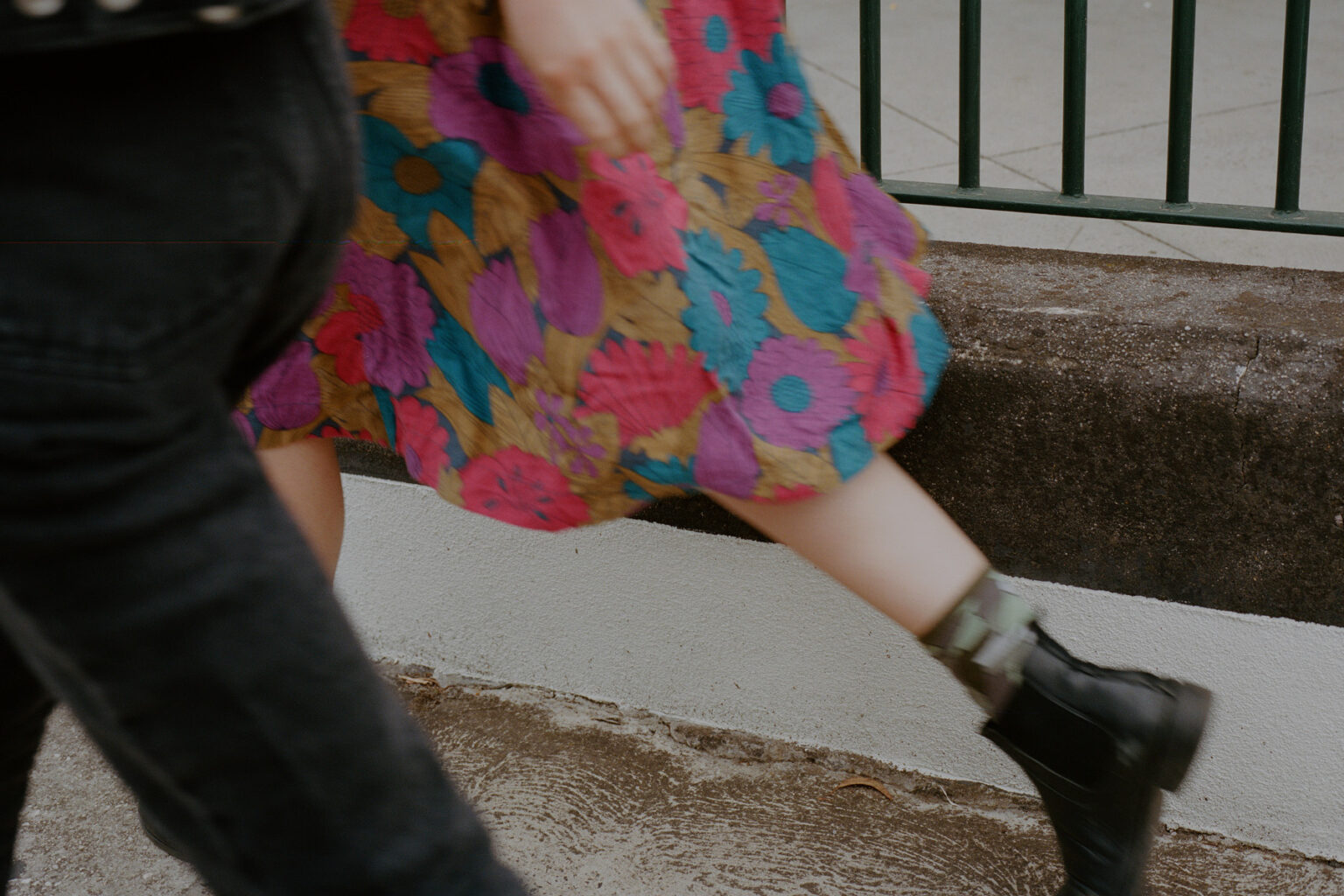
Image: Walking in Brunswick, Melbourne.
Bibliography
Anderson, Christy, David Karmon. “On Foot: Architecture and Movement.” The Architectural Review, 12 October 2015.
Badawi, Yostina, Francesca Maclean, Ben Mason. “The Economic Case for Investment in Walking.” Report for Arup and Victoria Walks, 2018.
Borden, Iain, Joe Kerr, Jane Rendell, Alicia Pivaro (eds). The Unknown City: Contesting Architecture and Social Space. London: The MIT Press, 2001.
Careri, Francesco. Walkscapes: Walking as an Aesthetic Practice. Ames: Culicidae Architectural Press, 2017.
Chatwin, Bruce. The Songlines. London: Vintage Classics, 1998.
Cook, Jessica, Mallika Bose, Wesley Marshall, Deborah Main. ”How Does Design Quality Add to our Understanding of Walkable Communities?” Landscape Journal vol. 32, issue 2 (2013): pp. 151–166.
Gros, Frédéric. A Philosophy of Walking. London: Verso, 2015.
Jacks, Ben. “Reimagining Walking: Four Practices.” Journal of Architectural Education vol. 57, no. 3 (Feb., 2004), pp. 5–9.
Moor, Robert. “Tracing (and Erasing) New York’s Lines of Desire.” The New Yorker, 20 February 2017.
Perec, Georges. Species of Spaces and Other Pieces. London: Penguin Books, 1997.
Rolls, Mitchell. “Why Didn’t You Listen: White Noise and Black History.” Aboriginal History vol. 34 (2010): pp.11–33.
Sim, David. Soft City: Building Density for Everyday Life. London: Island Press, 2019.
Solnit, Rebecca. Wanderlust: A History of Walking. London: Granta Books, 2014.
Speck, Jeff. Walkable City: How Downtown Can Save America, One Step at a Time. New York: North Point Press, 2012.
Tiwari, Reena. “Designing a Safe Walkable City.” Urban Design International vol. 20 (2015): pp.12–27.
Herzog, Werner. Of Walking in Ice: Munich–Paris, 23 November –14 December. Trans. Marje Herzog and Alan Greenberg. London: Vintage, 2014