An essay rethinking access and inclusion in our built environment by Jos Boys
Changing the Way We Think About Disability and Built Space
“Shifting the Ground” centres on challenging dominant assumptions about what it is to be disabled, both in relation to the design and delivery of the built environment and in society more generally. It first critiques ways of doing accessibility as a mere add-on to “normal” design processes; and then explores what happens if we start elsewhere – from disability and ability as complex and intersecting forms of embodiment; where our interactions with our built surroundings (as clients, designers, users and managers) are always relational, that is, a series of multiple encounters with objects, spaces and others that act to enable some people and disable others. In this understanding there are no simple “technical” solutions for making spaces truly accessible, but rather a commitment to collective care that aims to create environments in which everyone can flourish, as an ongoing and always unfinished process. The essay ends by suggesting that built environment professionals can engage with this more open-ended and critical understanding of “embodied space” both by paying attention to the diverse experiences of disabled people, and by reflecting on their own assumptions about whose bodies are valued.
Accessible Design as Retrofitting
Instead of reproducing commonplace architectural understandings of, or design guidance about, access and inclusion, I want to start with some basic, deeper questions about the “place” of disability, not just professionally but socially, culturally and politically. Why is disability somehow stuck as a functional and seriously underexplored category in relationship to building and urban design practices? Why is it almost entirely invisible in both avant-garde and mainstream architectural theories and discourses, except as a technical and regulatory add-on to “normal” design? It seems that we assume disability to be unable to bring any kind of criticality or creativity to the practice of architecture.
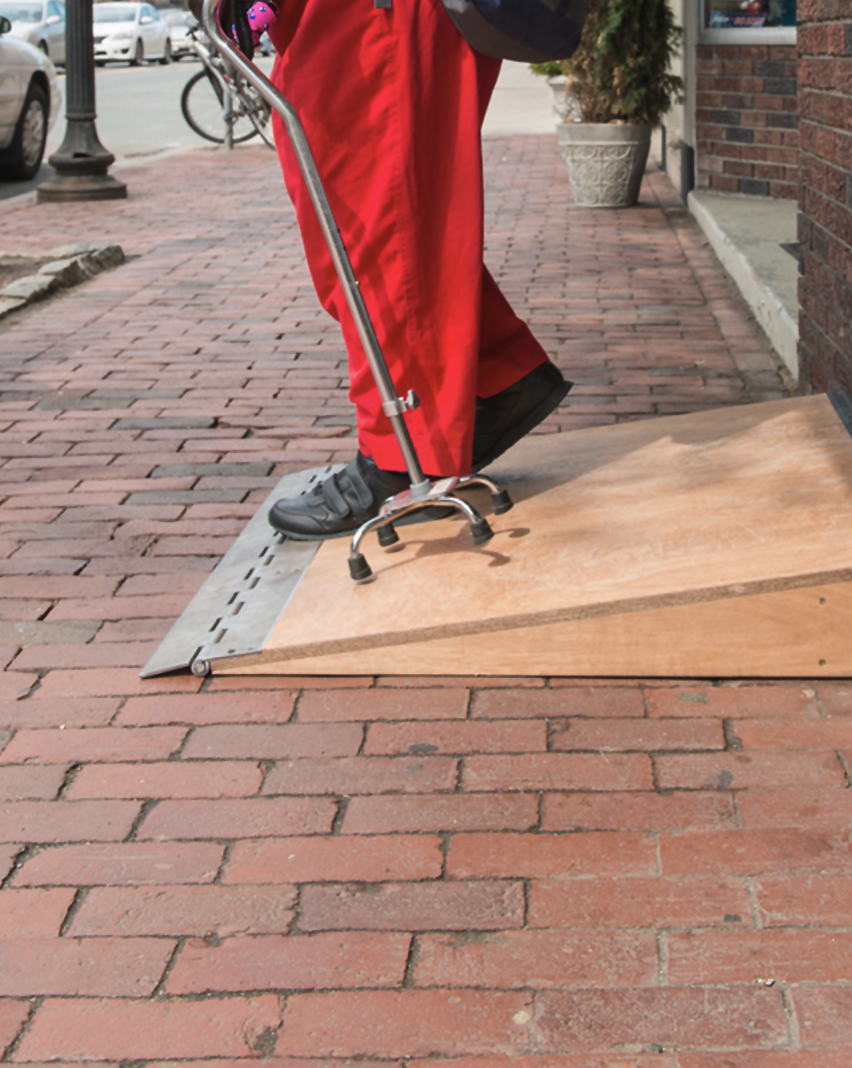
In fact, the way disability is framed in building design and delivery is decidedly odd. It takes the “normal” user as a starting point for design, and then “retrofits” (Dolmage 2008) for the “others” – adding on devices such as ramps and platform lifts to make buildings accessible to the very people who have already been excluded. Accessibility is dealt with as an afterthought, at the end of the design process and as a technical and regulatory problem, or a correction. Design guidance and building code locate disability outside of the creative design process, with templates available to copy-paste into schemes without the need for imagination, or design intelligence. This leads to a particular form of design “problem-solving”. Because disability is simplified into stable and predictable categories, “solutions” become easily codified into design guidance, leaving access to be treated differently to “normal”, partial, complex and creative design variables, such as site context or client briefing. As Margaret Price puts it:
The imaginative logic of using accommodation as a means toward access relies on the assumption that disability is stable and knowable, not only in moments – for example, when confronting a step or a time limit or an uncaptioned video – but in predictive ways. (Price 2016)
Disability is made “knowable” and controllable, at the same time as it is being misrepresented, reduced and trivialised. Design guidance is assumed to be objective, neutral and timeless, whilst simultaneously boring and restrictive to designers. Disabled people – assumed to have “special needs” – come to be seen as potentially problematic both for creativity, and for the aesthetics of “normal” built space. Having already been left out, disabled people then become the difficulty. At the same time, the much more nuanced and varied experiences of different ways of being in the world are made to disappear.
When design for accessibility is explicitly considered, it is usually delegated to specialist consultants, as if different, non-normative bodies and minds are just too complex for “normal” architects, developers and clients to engage with. Over the years, many non-disabled developers and designers have said to me that they feel ill-qualified and fearful about “getting it wrong” when it comes to working with disabled people. Is this because we (the non-disabled) still find it hard to see the person rather than the impairment? Because we assume that disability is inherently passive and pitiful, rather than listening to the perspectives of various disabled people, which might challenge such a view? Whilst there have been many access improvements over the last 50 years because of legislation, these fears – which prioritise non-disabled people’s own feelings and embarrassments over the needs of people with disabilities – continue to prevent good inclusive design, or deeper critical or creative rethinking about designing with difference; thinking that could revolutionise how building design and delivery engages with diverse bodies and minds.
Because accessibility is already assumed to be a difficult extra addition to “normal” procedures – it often seems too problematic to make much effort over, and any lack of achievement can be framed as a reasonable, even inevitable, response to constraints. Everyone agrees that more accessible facilities would be welcome, but (sadly) resources are scarce, buildings are too complicated to change and inclusive elements such as restrooms, lifts and ramps are expensive (and probably ugly). Current resource allocation focuses on making things as smooth as possible for the non-disabled, with anything that improves accessibility for disabled people assumed an unnecessary addition, that – if done at all – needs to be done as cheaply as possible (Titchkosky 2008, 2011; Siebers 2008).
Underpinning these commonplace attitudes and frameworks are a set of assumptions about disability that continue to marginalise people with disabilities, and to constrain the ways in which access and inclusion are made concrete in the built environment. We need an alternative starting point; one that recognises that human fragility, vulnerability and interdependence is the norm and not the exception; that our human bio- and neuro-diversity is a strength and not a weakness; and that design needs to include a concern with collective care, custodianship and repair.
Valuing Differences, Challenging Norms
To begin to unravel assumptions about disability and design, we need to start from our own various bodies and minds – opening up disability and ability as complex, ambiguous and relational ways of being shaped as much by everyday social, material and spatial practices as by specific impairments. This is to centrally understand disability in the context of what kinds of bodies are valued, in what situations, in forms that act to disable some people and enable others.
We live in a world where unencumbered independence, mobility, autonomy, personal competence, individualism and productivity are both highly valued and seen as ordinary and “natural”. People who are less than fully mobile, who are necessarily interdependent with others, or who appear less capable to navigate the world we create, are perceived as “difficult” because they don’t fit with this world and are assumed to need “special” adaptations to it. But the model of a fit, able, “always on” person is also problematic, and the built environment professions have their own variants of what constitutes the ideal bodymind (Price 2014). This includes valuing long working hours and obsessiveness, requiring the ongoing display of energy, commitment and drive, together with a disembodied neutrality and “balanced” professional behaviour. One aspect of this is that research, processing, reflection and evaluation are marginalised – often given no time. This puts pressure on students and practitioners to analyse problems at speed, to require bite-sized data to inform processes and to look for ready-made design solutions. In addition, such hyper-productivity is also individualised, that is, it becomes a personal failure if you are not achieving or performing “correctly”. By critically reflecting on preferred body types in different situations we challenge not only assumptions about disability and disabled people, but also how stereotypes about “what people are like” can act to disable – taking this term more widely – many of those who don’t fit the preferred norm in other ways, for example, are assumed less capable because of their gender, ethnicity, and/or skin colour.
Of course, our experience as human beings cannot be reduced to these, often harmful, assumptions or definitions – but we do live our relationships to these definitions and stereotypes – and to our own and other people’s beliefs about what constitutes a normal body, what ordinary behaviour looks like and what is a satisfactory life. Both our common-sense attitudes and our everyday social and spatial routines are daily enacted, re-made and challenged through continual processes of negotiation between our own bodyminds and our encounters with objects, spaces and others. This is true for everyone, but for disabled people (as for many of those also labelled as “other”) this is not a level playing field. This is because stereotypes are perpetuated through an un-thought-about framework of assumed characteristics. First, disability is framed in binary relationship to able-bodiedness; simultaneously opposed and made inferior to it. One side of the binary becomes less satisfactory (and even less human), whilst the other – whiteness, masculinity and ability – is coded as unproblematic and unmarked, or “normal”. Disability (along with other categories of “other”) becomes inherently marked as a problem, simultaneously over-exposed and made invisible. At the same time, strings of associated qualities – rational, competent, independent versus irrational, incompetent, dependent – act to reinfornce the common sense of such divisions. This framing becomes a convention about how the world works. Disability is seen as a deficit, a lack; and the “answer” for the built environment and the wider culture, is some kind of compensation for this lack, which in architectural terms usually means retrofitted assistive devices.
Yet simplistic disability categories – blind, deaf, wheelchair users, etc. – do not begin to reflect the complex realities of diverse disabled people’s lives, whose experiences of impairment are likely to be much more uneven, dynamic and multiple. People who use wheelchairs may have very different experiences and access requirements from each other. People with different impairments have a range of preferences and desires that cannot be neatly packaged into homogenous categories. People may be born with an impairment or develop one later in life; it might be chronic, variable, invisible or short-term. Disability is also inherently interconnected with other identities such as race, gender and sexuality (Kafer 2013). This is both within the conventional divisions – wheelchair user, deaf, blind, autistic – and across different impairment categories. Disability is also about multiple issues, as deprivation, war and discrimination are all likely to produce more disabled people. For these reasons, people of colour and those in poverty are more likely to be disabled than their white or wealthier counterparts; and disability is more prevalent and differently framed in the global south, compared to the global north (Erevelles 2011).
In fact, the very diversity of all our bodies makes even defining disability partial, difficult and shifting. Is being obese a disability? Or having cancer? Or a chronic illness? Definitions of who is disabled and who is not change through time and circumstance – they may be based on the fact of impairment but are also socially and culturally constructed; as are societal assumptions that naming disability is straightforward. Just like non-disabled people, diverse disabled people also have a variety of ways of making sense of, and surviving in, the world. Jess Thom, a neurodivergent performer and writer, recently created a diagram (Fig. 1) that explores and explains her own personal experiences of coming to identify positively and politically as a disabled person. This is important. All too often disabled people are asked to participate in design processes as if they are “authentic” representatives for a whole impairment category. This fails to recognise both bodymind complexity and the varieties of ways disabled people place themselves in relationship to wider societal views.
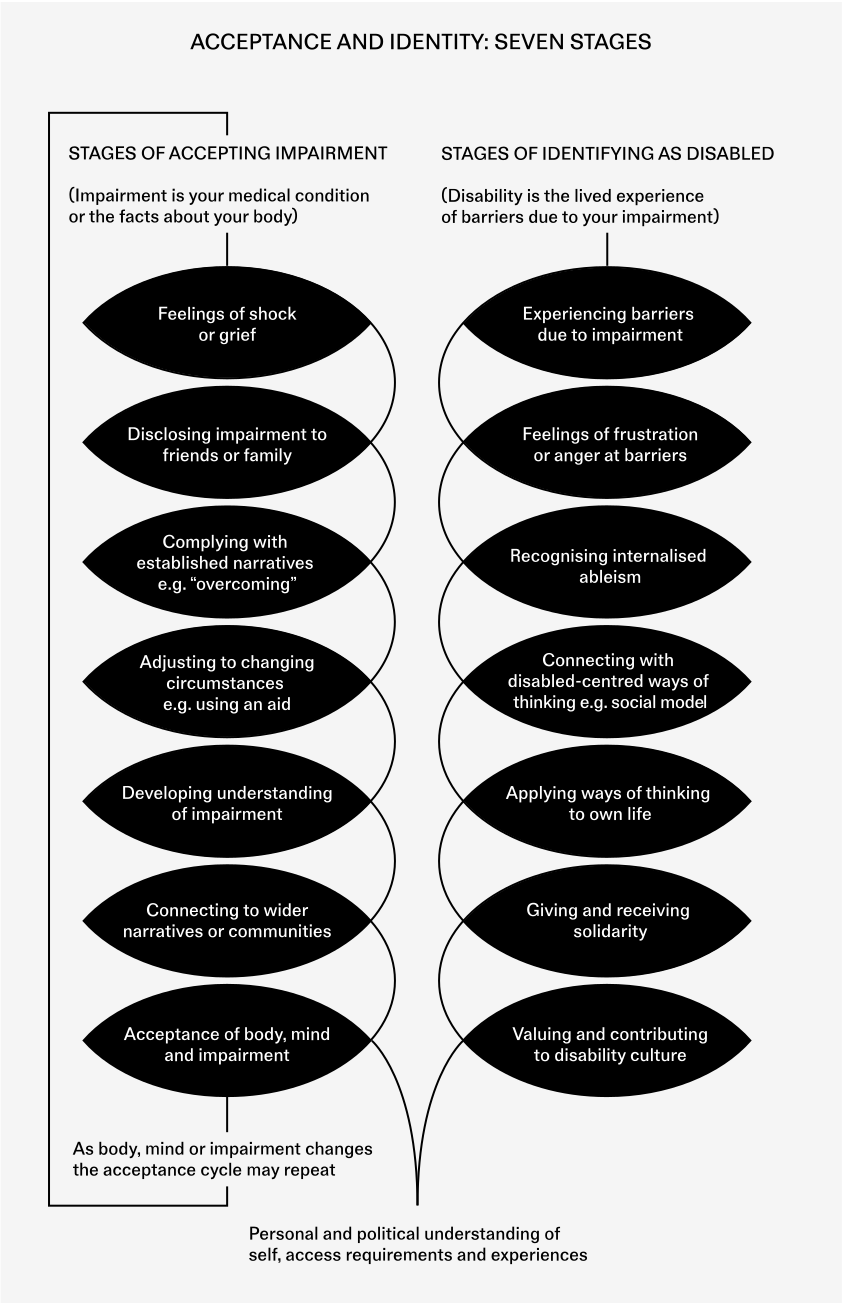
Fig 1. Diagram adapted from Jess Thom’s “Acceptance and Identity: Seven Stages”, as published on her Touretteshero blog, 2020.
Non-disabled people, too, can reflect on their changing attitudes to disability and ability. In Fig. 2, I suggest seven equivalent stages that non-disabled people might go through in moving from fear and embarrassment around disability towards connection and solidarity. The first step in shifting the ground more widely around everyday attitudes to disability, then, is for each of us non-disabled people to consider where we are positioned on this journey, and to reflect on how we might change.
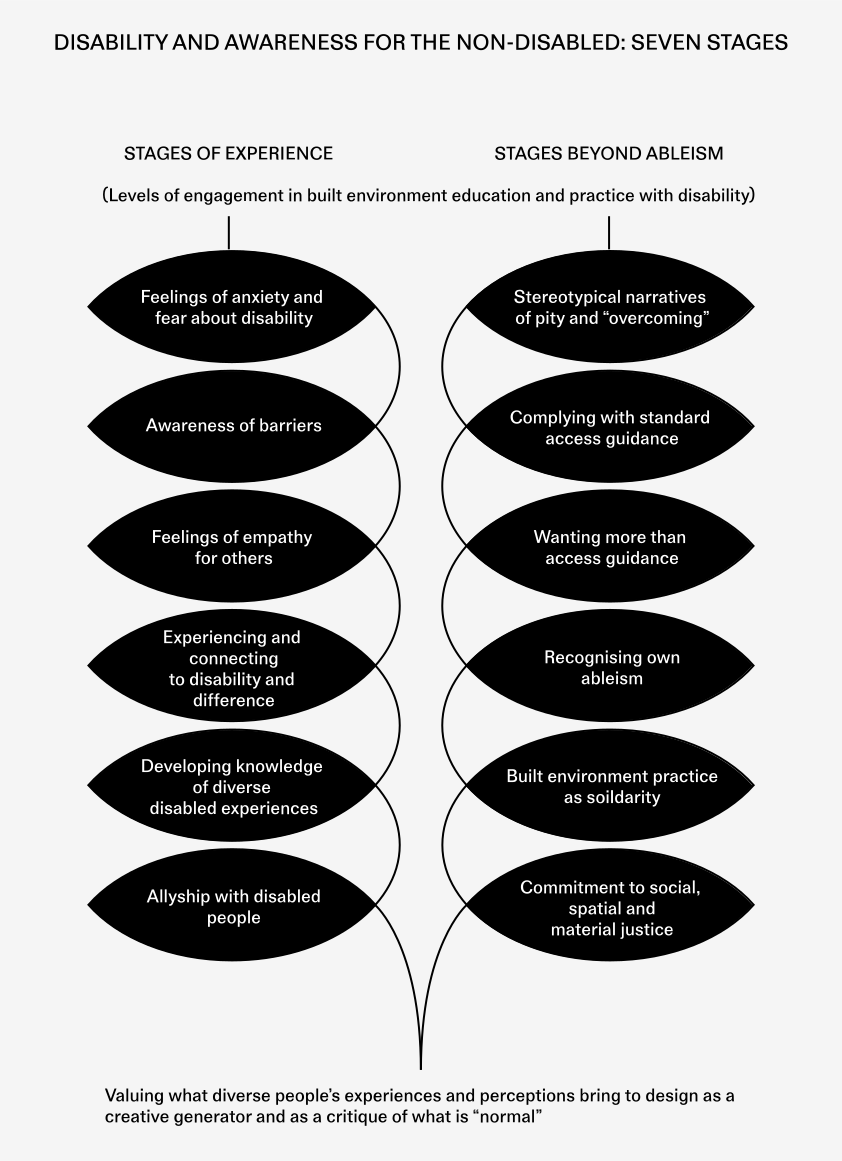
Fig 2. Diagram adapted from Jos Boys’ “Disability and Awareness for the Non-Disabled: Seven Stages”, 2020.
One way to resist everyday binary oppositions and stereotypes of ability and disability is to work with alternative concepts, informed by disability studies, arts and activism. Disability studies scholar Rosemarie Garland-Thompson, for example, uses the ideas of “fitting” and “misfitting”. She argues that the critical concept of the misfit is a valuable way of thinking through the lived identity and experience of disability (and other identities) as these are situated in place and time. It is a way of investigating how our diverse embodiments interact with the environment, across its spatial, temporal and social aspects. As she writes:
a misfit occurs when world fails flesh in the environment one encounters whether it is a flight of stairs, a boardroom full of misogynists, an illness or injury, a whites-only country club, sub-zero temperatures, or a natural disaster… An embodied engagement with world is in fact life itself. (2011: 600)
Processes of fitting and mis-fitting are thus inherently dynamic, relational, interconnected and specific, in a way that binary stereotypes are not. And crucially, concepts of fitting and misfitting include everyone. By investigating what particular interactions between bodyminds, objects, space, people and settings act to disable some and enable others, this framework recognises that all humans can be vulnerable. It is a way of connecting with our shared human fragility and a method for interrogating everyday practices and spaces to highlight where these act to misfit some and not others. It also throws into focus if you are someone who fits “smoothly” with the world – with few bumps or obstacles in your way – and enables the recognition of this as a site of privilege, not normality, that should demand critical reflection. In fact, ease of fit is the least creative place to be, because it doesn’t require you to pay attention to your surroundings, or your assumptions about your place in the world. On the other hand, having a non-normative bodymind actually increases your creativity because you are forced to continually take notice of, and negotiate, places and social encounters. It is disabled people who are the creative experts in the design and occupation of built spaces – they have to be.
Importantly though, starting from the idea that we all have differences and vulnerabilities is not the same as implying that we are all “similar” in our experiences. Misfitting means many frustrating and exhausting inconveniences and barriers when the built environment does not fit with your way of being in the world. Although we may all misfit momentarily, the sheer force of “ordinary” – that is, ableist – social, spatial and material practices work persistently and differentially against people with disabilities. It prevents some people from going out; from partaking in “normal” activities; creates additional tiredness and discomfort; and demands endless additional emotional labour for dealing with non-disabled people’s assumptions. There is considerable work involved here, both to perpetuate such practices, and to resist and transform them (Boys 2014).
Disabled people are also developing other concepts that disrupt binary stereotypes. One is a kind of reverse labelling to describe non-disabled characteristics, such as “normates” and “neurotypicals”. Another is to frame daily life from a disabled perspective. Examples are crip time, spoons and care work, all of which have interesting implications for rethinking barriers in built environment design. It is important not to appropriate these terms into architectural design and development without taking proper notice of disability-led debates or explicitly crediting sources. But for me, disrupting conventional design and development terminologies with concepts from outside the profession is a vital way forward. Crip time is partly about recognising the realities of speed and slowness for different people, in negotiating everyday activities and spaces. But it also has a wider political meaning, as a deliberate challenge to the pressures on all our bodies to be productive and to feel guilty if we are not (Raghavan 2020). Crip Space Time is a term currently being developed by disability studies scholar, Margaret Price, to highlight how even whilst people appear to occupy the same space, the dynamic complexities of not just differences in access but also affective impacts and intangible knowledge, mean that experiences are differentiated and unequal (Price, forthcoming). Spoons focuses on energy – Spoon Theory is increasingly used across disabled and other marginalised groups to describe the exhaustion produced by specific situations and spaces. It is most commonly used by people with invisible disabilities, but also opens up to critique the disabling effects of spaces and encounters that are energy draining in a variety of ways. Care work rethinks access as a form of collective love – about which, more later – both as an idea and as a form of practical organising and support. How can we understand care as a positive interdependency, and explore how it can be requested and given easily and fairly (Lakshmi Piepzna-Samarasinha 2018; Mingus 2017)?
Access as an Emergent, Collective Practice
If disability and ability are understood as relational, unstable and dynamic, then we also need to have a way of re-imagining design and delivery processes that takes this complexity into account. What does it mean to design with difference, in order to create spaces that start from enabling a multiplicity of ways of being in the world, and supports human flourishing in all its variation? This requires a huge shift in current design and development professional habits. There is no longer a quick answer from design guidance, or even from access consultants (however improved they can make a “normal” design). Instead, disability in all its diversity becomes just another – crucial – variable in how we creatively engage with different ways of being in, and making sense of, the world. “Normal” design and development processes already start from just such complex, partial, non-compatible and unpredictable variables. Design is inherently based on analysing situations about which we do not know enough, and predicting how to instigate social, spatial and aesthetic improvements through the transformation of material space and objects. Why – one has to ask – has disability come to be treated so differently?
A key question for the built environment sector, then, is how this more emergent, open-ended and creative understanding can underpin contemporary design and development processes in ways that can make real improvements, both to built space, and to disabled people’s lives. Across disability studies, many scholars, artists, designers and activists are exploring this problem. Instead of access being a clearly bounded set of requirements distinct from “normal” non-disabled life, our needs across bodyminds are articulated as more fluidly interconnected and diverse. Rather than separate disability categories, access requirements cross between divisions, both as aligned and contradictory needs. And in developing a shared understanding of these complex and changing patterns, we come together through a commitment to the notion of collective care. Activities such as Critical Design Lab’s “Mapping Access” (and Hamraie 2018): The Disability Visibility Project’s “Access is Love” (see also disabilityvisibilityproject.com): Sara Hendren’s book, What Can a Body Do? (Hendren 2020) and Liz Jackson’s “The Disabled List” are all, in different ways, aiming to create processes that reframe access and inclusion as ongoing and emergent; a practice that recognises difficulties and differences in access requirements but also enables access to take place, creatively and positively. These and other examples are detailed in the resources section.
And if access and inclusion are an always emergent, uneven and unfinished collective responsibility, then it doesn’t stop with a building being designed, but requires ongoing monitoring and adaptation, care and repair. The Ed Roberts Campus at Berkeley in California is an interesting example of this approach in practice. Designed by Leddy Maytum Stacy Architects, it opened in 2011 and remains an iconic example of an accessible building, led and operated by disabled people (Fig. 3).
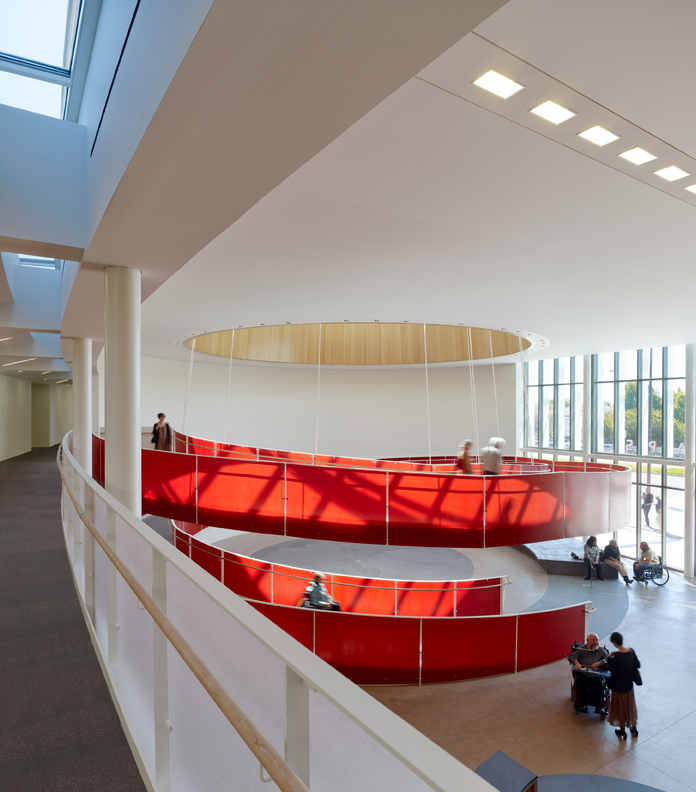
Fig 3. Internal view of the Ed Roberts Campus, Berkeley University of California, 2011. Designed by Leddy Maytum Stacy Architects. Photo by Timm Griffith.
The scheme is named in honour of Ed Roberts (1939–1995), a pioneer of the disability rights movement. After his death, a disabled group came together to develop an inclusive campus for organisations that provide services to disabled people. More recently however, its many and diverse users are widening and shifting ideas about inclusive design (Kullman 2019). As Kullman shows, a building that was designed out of a particular historical moment of disability activism has had to shift and supportively adapt to, for example, the experiences of autistic people and of people with environmental sensitivities. For these newer generations, disability is not so obviously framed around identity categories such as wheelchair users, blind or deaf people, or focused on “barriers” that can be designed out. Kullman suggests that the people with environmental sensitivities he talked to were much more concerned to explore the intersections between their vulnerabilities, and the requirements of other disabled people in the building; recognising tensions and multiple needs as a means to develop improvements, rather than by first defining the “needs” of different impairment groups and then somehow adding these together to produce a “universal design”.
Kullman’s research highlights the vital role of ongoing service support in managing these tensions productively, and illustrates how building maintenance and caretakers – mostly disabled people at the Ed Roberts Centre, in a supported employment scheme – respond to complex differences positively and creatively. This is ongoing detailed work that is often framed as problematic – as a “wasted” resource in conventional building services and management – because it takes time and connection to support individual adaptation of, for example, building-wide ventilation, heating and lighting systems. This project’s continuing commitment to meeting diverse needs is a great illustration of access as collective care.
Addressing Compliance
The alternative approaches and concepts offered here aim to open up built environment design and delivery to new creative and critical ways of thinking and doing. However, in day-to-day working practices developers and designers still need to follow existing – and often limiting – building codes and regulations. Just as stereotypes of disability are socially constructed, so also are regulatory requirements. These are not merely neutral and technical but have particular histories and geographies. Unravelling these stories in relation to disability and ability is a vital but considerably under-researched field of study. Aimi Hamraie’s seminal 2017 book, Building Access: Universal Design and the Politics of Disability, was one of the first such project, with related publications only just beginning to appear (Guffey 2017, Williamson 2019). Hamraie uses extensive archival research to show how concepts of Universal Design (UD) in America – often defined as designing an environment to meet the needs of all people who wish to use it – changed through time, away from the original intentions of the disabled campaigners involved.
Beginning to understand how we come to have particular building codes related to accessibility (and to notice how these are shifted or contested across place and time) does not always help when working on a project. Committed developers, clients and architects can and often do aim to design for inclusion beyond building code, challenging the assumptions that tend to marginalise accessible elements as a resource drain. “Stalled!” is an example of a project that does not just re-think inclusive design, but also challenges existing building codes. This is a campaign led by Joel Sanders Architects with transgender scholar Susan Stryker and lawyer Terry Kogan, that aims for the complete rethinking of public toilet design, by going beyond sex-segregated versions of public conveniences to propose all-gender spaces, where separation is not by gender or disability but across public and private aspects of using such space. As well as starting by critically investigating the history of public restrooms in the US, and creating a variety of promotional initiatives and events, “Stalled!” includes a lawyer who has argued in court for building code changes in particular cases, to support these radical design proposals.
In arguing for moving beyond compliance-based design to a real engagement with diverse embodied experiences of the world, I do not underestimate the enormity of the changes required. I have emphasised the centrality of changing attitudes – starting from each of us – because without different mindsets, conventional design, social, cultural and political processes will continue to reproduce harmful definitions or unhelpful narratives around disabled and other non-normative bodyminds. This in turn needs to lead to more radical thinking and campaigning around built environment access and inclusion; the development and amplification of good practice underpinned by disability-led perspectives; and to a world where non-disabled professionals act in solidarity with disabled (and other disadvantaged) groups in support of creating and maintaining built surroundings that are centred on human flourishing.
Notes on terminology
There are different ways of referring to disability. In some places, the preference is for what is called person-first language (people with disabilities), in others identity comes first, as a form of disability pride (disabled people). The latter tends to be used in the UK, and is the term mainly used in this essay. In Australia, person-first language is the preferred terminology. In addition, many Deaf people, particularly those who use sign language, see themselves as a linguistic minority with their own language and culture, and therefore do not define as disabled. The use of a capital D for Deaf recognises this differentiation.
Disabled activists have long argued for a the shift from the medical model of disability which sees impairment as a personal tragedy in need of cure; to the social model which focuses on disability as primarily constructed by societal and physical barriers. More recently activists and scholars often use what might be called a relational model (Kafer 2013). This is the framework used in this essay. It unravels how people are disabled through the complex interrelationships between different bodies, minds, objects, spaces and encounters.
Bibliography
Boys, Jos. 2014. Doing Disability Differently: an Alternative Handbook on Architecture, Dis/ability, and Designing for Everyday Life. Oxon: Routledge.
Dolmage, Jay. 2008. “Mapping Composition: Inviting Disability in the Front Door.” in Disability and the Teaching of Writing: A Critical Sourcebook, edited by Ed. C. Lewiecki-Wilson and B. J. Brueggemann, with J. Dolmage,14–27. Boston, MA: Bedford/St Martin’s.
Erevelles, Nirmala. 2011. Disability and Difference in Global Contexts: Enabling a Transformative Body Politic. London: Palgrave Macmillan.
Garland-Thompson, Rosemmarie. 2011. “Misfits: A Feminist Materialist Disability Concept.” Hypatia: A Journal of Feminist Philosophy 6, no. 3 (Summer): 591–609.
Guffey, Elizabeth. 2017. Designing Disability: Symbols, Space, Society. London: Bloomsbury Academic.
Hamraie, Aimi. 2018. “Mapping Access: Digital Humanities, Disability Justice, and Sociospatial Practice.” American Quarterly 70, no. 3: p. 455-482.
Hendren, Sara. 2020. What Can a Body Do? How We Meet the Built World. London: Penguin Random House.
Jackson, Liz. 2019. “Empathy Reifies Disability Stigmas.” Accessed February 28 2021.
Kullman, Kim. 2019. “Politics of Dissensus in Geographies of Architecture: Testing Equality at Ed Roberts Campus, Berkeley.” Transactions of the Institute of British Geographers, vol 44, no. 2: pp. 284-298.
Lakshmi Piepzna-Samarasinha, Leah. 2018. Care Work: Dreaming Disability Justice. Vancouver: Arsenal Pulp Press
Mingus, Mia. 2017. “Access Intimacy, Interdependence and Disability Justice.” Leaving Evidence, Accessed March 1 2021.
Price, Margaret. 2016. Moving Together: Toward a Theory of Crip Spacetime. Montreal: National Women’s Studies Association.
Price, Margaret. 2014. “The Bodymind Problem and the Possibilities of Pain.” Hypatia 30, no. 1 (November): 268–284.
Raghavan, Srinidhi. 2020. “The Value of ‘Trip Time’: discarding Notions of Productivity and Guilt, to Listen to the Rhythms of your Bodies.” Firstpost. Accessed February 28 2021.
Siebers, Tobin. 2008. Disability Theory. Ann Arbor: University of Michigan Press.
Thom, Jess. 2020. “Acceptance and Identity – Seven Stages.” Touretteshero blog, Accessed February 25 2021.
Titchkosky, Tanya. 2011. The Question of Access: Disability, Space, Meaning. Toronto: University of Toronto Press.
Williamson, Bess. 2019. Accessible America: A History of Disability and Design. New York: New York University Press.