Selected by Jos Boys, edited by Nadine Monem and Frankie Moutafis
The resources in “Designing and Delivering Differently” have been selected by Dr Jos Boys and provide examples of practical methods for doing disability differently in design and development. The material here challenges conventional design processes, and demonstrates how disability can be a creative generator. These resources, while not exhaustive, are deliberately organised by concepts generated by disabled practitioners to support creative and critical engagements with disability, access and inclusion.
The resources in “Designing and Delivering Differently” have been selected by Dr Jos Boys and provide examples of practical methods for doing disability differently in design and development. The material here challenges conventional design processes, and demonstrates how disability can be a creative generator. These resources, while not exhaustive, are deliberately organised by concepts generated by disabled practitioners to support creative and critical engagements with disability, access and inclusion.
Care Work
David Serlin, “Pissing without Pity: Disability, Gender and the Public Toilet”, 2017 Reprinted from Harvey Molotch and Laura Norén (eds) (2010) Toilet: Public Restrooms and the Politics of Sharing
In “Pissing without Pity” David Serlin shows how public conveniences, including accessible facilities, have been contested through time; using that as a starting point to critique the assumption that merely providing a disabled toilet to minimum space standards somehow solves the ‘problem’. David sees such discourses of equality as flattening differences – reinforcing ideas of disabled categories as homogeneous whilst continuing to support spaces for normative bodies. By engaging with contemporary debates around gender-neutral toilets, he aims to open up debate to its social, cultural and political implications.
Tanya Titchkosky, “To pee or not to pee? Ordinary talk about extraordinary exclusions in a university environment” in Canadian Journal of Sociology, 2008
“To Pee or Not to Pee?” is chapter four of Tanya Titchkosky’s text The Question of Access: Disability, Space, Meaning, and discusses inaccessible washrooms within educational workplace environments. Titchkosky presents the university as a space to reflect critically on disability narratives and asks us to consider universities as socio-political sites where ideas around disability are produced and circulated.
Disability Visibility Project, Access Is Love
Founded by disability activists, Alice Wong, Mia Mingus and Sandy Ho, the Access Is Love campaign advocates for a collective and expansive approach to access and “aims to help build a world where accessibility is understood as an act of love”. The campaign presents a list of readings, resources and suggested actions individuals can take to expand their knowledge of accessibility and disability justice, whilst the online hashtag encourages online conversation and discussion around these topics. See also Irresistible podcast 46: Access is Love with Alice Wong.
Mia Mingus, “Access Intimacy: The Missing Link”, 2011
In “Access Intimacy: The Missing Link”, writer, educator and disability justice advocate, Mia Mingus, explores the self-coined term “access intimacy” which Mia describes as “that elusive, hard to describe feeling when someone else ‘gets’ your access needs”. Mia recounts her myriad experiences of the feeling, such as the instant access intimacy felt towards disabled and sick people, borne from a shared understanding of access needs, to the absence of the feeling amongst those closest to her. An ever-evolving emotion, Mia finishes by recognising the importance of access intimacy in order to establish “a true connection”.
Kelsie Action, “Remarkable” in Sync Leadership Blog, 2020
In the short video, “Remarkable”, Kelsie Action offers a brief description of how disabled people often work together to make space as inclusive as possible, showing how this is often an imperfect but positive process.
Shannon Finnegan, Anti-Stairs Club Lounge, 2018
A series of interactive installations, the Anti-Stairs Club Lounge confronts the inaccessibility and ableism of exhibition spaces by creating exclusive areas for visitors who are unable to travel upstairs. These interventions are intended as comfortable and welcoming spaces where visitors can relax, read and enjoy a refreshment. One such ‘lounge’ was placed within the Wassaic Project’s exhibition space in New York, a seven-story building with no ramps or elevators past the first floor rendering it inaccessible for those less able to walk upstairs. These lounges counteract the excluding design of these buildings by creating spaces unique to those with disability.
Jess Thom and Battersea Arts Centre, Relaxed Venue, 2020
Battersea Arts Centre is striving to make the entire experience of visiting a venue more welcoming, accessible and inclusive. Though Arts Council England funding, the Centre has been working with Touretteshero – a company co-founded by Jess Thom in 2010 as a creative response to her experience of having Tourettes Syndrome, co-developing a methodology that can be applied to other organisations wanting to rethink their approach to access. The Relaxed Venue method takes the principles that guide Relaxed Performances and applies them across all of an organisation’s spaces and programmes. Relaxed Performances were originally devised to make performances more accessible to people disabled by the usual rules of theatre etiquette. The principles encompass everything from clear, understandable advance information, to taking a relaxed approach to movement and noise coming from the audience.
Crip Time
Margaret Price, “Moving Together: Toward a Theory of Crip Spacetime” in Crip Spacetime: A Re-orientation to Disability Studies, forthcoming
In this lecture author and disability scholar, Margaret Price discusses her theory of crip spacetime which she established to address “ the radical inequality of the different spacetimes we inhabit”. The theory of crip spacetime views access from a sustainable standpoint, advocating for an approach within academia and disability studies which considers the interconnectivity between individuals, space and time.
Srinidhi Raghaven, “The Value of Crip Time”, 2020
Srinidhi Raghavan explores the concept of time in relation to the crip experience, a type of time which should be flexible and considered in relation to the bodies ability; “rather than bend disabled bodies and minds to meet the clock, crip time bends the clock to meet disabled bodies and minds”. Raghavan speaks of her struggles in attempting to meet “normal” times productivity expectations and the pleasure in finally “living within crip time”, which works around her body’s personal abilities and needs.
Ellen Samuels, “Six Ways of Looking at Crip Time” in Disability Studies Quarterly, 2017
In “Six Ways” Ellen Samuels reflects on how to explain the concept of crip time through their own life experiences in ways that combine its liberatory possibilities as a challenge to normative time, with some of the less appealing aspects – considering how disability and illness “extract us from linear, progressive time with its normative life stages and cast us into a wormhole of backward and forward acceleration, jerky stops and starts, tedious intervals and abrupt endings”.
Alison Kafer, Feminist, Queer, Crip, 2013
This book is divided into seven thematic chapters, including concepts of ‘crip time’, female sexuality and disability, heterocentrism and ableism, and the possibility of cripped cyborg politics, environmental politics and disability. She concludes with an outlook on feminist, queer, crip futures and coalitions. Alison defines crip time as a shift in mindset: ‘rather than bend the bodies and minds to meet the clock, crip time bends the clock to meet disabled bodies and minds’ (p27).
Multimodality
Kathryn Linn Geurts, “Senses” in Keywords for Disability Studies, 2015
Keywords for Disability Studies offers a new vocabulary for disability studies, bringing together a collection of sixty-two essays which cover key concepts across the history of the field. The terms explored include types of disability models such as ‘medical’ and ‘social alongside tropics such as ‘ability and ‘vulnerability’ which are brought together to create a conceptual reference document for both students and scholars. The volume unifies with expanding theories and debates around Disability Studies and generates important questions.
Chris Downey, Art of Now: Hearing Architecture, podcast, 2020
Architect Chris Downey walks around San Francisco, narrating his acoustic experience of the built city whilst recalling his experience of becoming blind and continuing his practice as an architect with renewed focus on the acoustic and tactile experience of a building. Downey highlights how consideration for touch, sound, air flow and temperature not only create more inclusive built environments but enhance and improve the experience of these spaces or all.
Christine Sun Kim, “[Closer Captions]”, in Pop-Up Magazine, 2020
Christine Sun Kim explores the conceptual uses of sound through drawing, painting and performance. In this video performance, the artist critiques conventional captioning by developing her own narrative and highly descriptive closed captions, demonstrating the potential to create deeply emotive experiences through the use of expressive language. Here verbal description becomes both a rich creative tool, and an integrated enhancement to the visual images.
Yergeau, Remi M, Elizabeth Brewer, Stephanie Kerschbaum, Sushil Oswal, Margaret Price, Michael Salvo, Cynthia Selfe and Franny Howes. “Multimodality in Motion: Disability and Kairotic Spaces,” in Kairos: A Journal of Rhetoric, Technology and Pedagogy, 2013
“Multimodality in Motion” is a multi-author and interactive set of webtexts that explores issues around deliberately offering multiple forms of engagement with writing – relevant to designers, since composing and reading texts is seen as completely integrated with embodied experiences in conceptual, virtual and physical spaces. Whilst challenging some mechanical ways of making texts/spaces multimodal that assume an able-bodied composer or inhabitant (merely ‘adding-on’ alternative versions for the ‘others’) these pages consider how to aim towards making everyone feel invited into, and imagined as part of, a text/space.
Spoons
Christine Miserandino, “Spoons Theory” in But You Don’t Look Sick blog, 2003
Spoons Theory is a metaphor used to describe the amount of mental or physical energy a person has available for daily activities and tasks. The theory was developed by Christine Miserandino as a way to express how it felt to have lupus, and is most often used in relation to invisible disabilities and chronic illnesses.
Liz Crow “Lying Down Anyhow” in Disabling Barriers – Enabling Environments, 2013
In “Lying Down Anyhow” Liz Crow considers the rebellious act of lying down in public spaces beginning her analysis with an autobiographical piece. She later explores the cultural and societal codes that govern the body’s way of being and that make lying down in a public place a defiant act. Liz goes on to explore the negative linguistic connotations of the term ‘lying down’ which is related to laziness and shamefulness.
Raquel Meseguer, A Crash Course in Cloud-Spotting, 2020
A Crash Course in Cloudspotting (the subversive act of horizontality), conceived and performed by artist Raquel Meseguer, is “an ode to invisible disability”. The project – which invites audience participation – brings to light the experience of neurodiverse people; those that need to rest throughout the day, accounting for a significant portion of disabled people. Through the subversive act of lying down in public spaces, the artist questions the etiquette of these spaces whilst highlighting the needs of those with energy impairments.
Raquel Meseguer, “Why I Want to Lie Down in Public”, BBC Radio 4 Film, 2018
Raquel Mesegue has lived with chronic pain for a decade, resulting in her needing to lie down and rest her body frequently throughout the day. In this short video Raquel discusses the effects the pain has on her daily life whilst campaigning for public spaces which invite people to lie down in a bid to destigmatise the act of lying down in public which she sees as positive and regenerative: “We generally think that slowing down is a bad things, but maybe it’s not, maybe it’s actually a very creative, brave thing to do”.
Podcast: ‘Dreams of Public Resting Spaces’ BBC Radio 4 Four, 2018
Raquel Meseguer, discusses the backlash she receives from lying down in public spaces, something she is required to do in order to ease her chronic pain. Charting her experiences at public arts venues, theatres and trains – where the act of lying provides problematic and prompts kickback – Racquel contests for a better consideration of ability differences and a rethinking of social etiquette which would remove prejudice against her fellow ‘Cloudspotters’ – her euphemism for people with invisible differences.
Noa Winter, “Aesthetics of Horizontal Access – An Ode to Lying Down in Art Spaces”, 2020
In this writing, curator and dramaturg Noa Winter discusses horizontal access and the aesthetic experience of lying down. Noa begins by identifying horizontality’s link to a lack of productivity, which is regarded negatively within our neoliberal society and how by being horizontal you are defying and disrupting societal and ableist norms. Noa then goes on to speak of the unique aesthetic horizontal experience which should be recognised, pointing to examples of work which value horizontality such as The Nap Ministry, founded by Tricia Hersey, which challenges white supremacy through site-specific installations which invite participants to rest.
Joel Sanders and Diana Fuss, An Aesthetic Headache: Notes from the Museum Bench, 2015
Centred around the creative possibilities of the museum bench, Diana Fuss and Joel Sander’s essay chronicles the history of the ubiquitous object whilst highlighting the lack of consideration given to the objects design and its relation to the spectator’s body. Fuss and Sanders calls for an acknowledgment of the importance of gallery furniture which has “become, over time, an object of suspicion and even derision” but which acts as a key component in the gallery experience.
Lifehacks, Adaptive Delivery and Design Customisations
Bess Williamson, The People’s Sidewalks: Designing Berkeley’s Wheelchair Route, Boom California, 2012
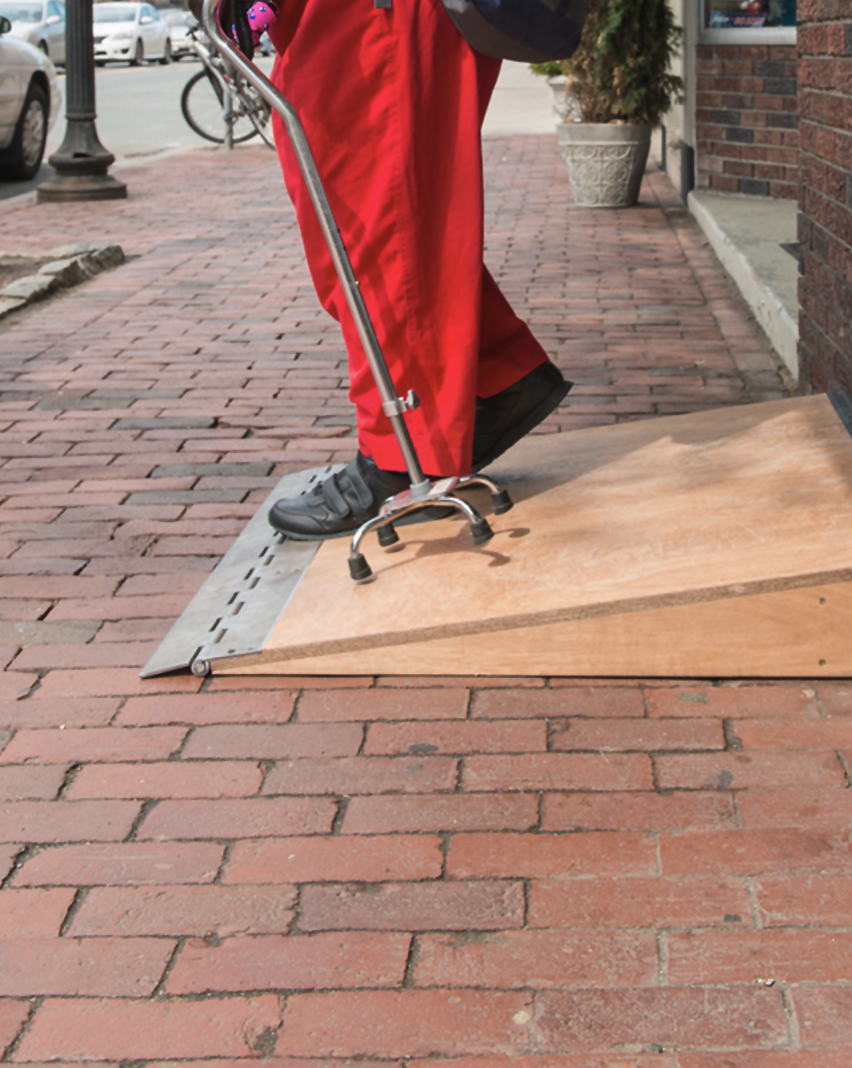
Bess Williamson’s The People’s Sidewalks, recounts the disability-led movement taking place between 1970–1974, which campaigned for great accessibility on the streets of Berkeley, California. Led by a residents of Cowell Hospital, one of the few accessible public spaces in Berkeley – in an era prior to governmental requirement for accessible spaces – the community both campaigned for and assisted with the redesign of the streets, including the introduction of curbs which dramatically reformed sidewalk use for the areas large number of wheelchair users.
Vivian Sobchack, “A Leg to Stand on: Prosthetics, Metaphor and Materiality”, In The Prosthetic Impulse: From a Posthuman Present to a Biocultural Future, 2006
“In a Leg to Stand On” Vivian Sobchack explores the relationships between her own experiences of having a prosthetic leg and the way in which prosthetics are so often conceptualised as cyborg technologies. She is curious about the juxtapositions between the imagined seductiveness of cyborg bodies and the everyday ways her own device acts as a literal support. She writes resonantly about interesting intersections between these different world views.
Aimi Hamraie and Kelly Fritsch, “Crip Technoscience Manifesto”, n.d.
In this article, disability scholars Aimi Hamraie and Kelly Fritsch explore crip technoscience which they define as “politicised design activism”. They call for a great acknowledgement of disabled peoples’ lived experiences in the work of technoscientific intervention, which comes from the acknowledgement that technologies that enable disability access in built spaces, are produced through “military-industrial research and development, imperial and colonial relations, and ecological destruction, all of which contribute to the uneven debilitation of human and non-human life”.
Sara Hendren and Amanda Cachia, Alterpodium, 2016
Alterpodium takes the form of a portable disability object, aimed to critique the built environment’s bias toward one body type and size; the “normative” form. The custom-build, collapsible podium acts as a performative prop, which is used during international and national conferences, symposiums, and lectures by Amanda Cachia, an independent curator and PhD Candidate in art history, theory and criticism in the Department of Visual Arts at the University of California San Diego, As someone with dwarfism, Amanda can use her own podium as both an inclusive device, and an act of “performing disability”, that disrupts spatial norms.
Frani O’Toole, Disability x Maternity A ‘Household User’s Manual for Young Mothers with Disability, 2020
In this project Frani O’Toole collaborates with her disabled mother to explore the intimate material details of home as a landscape of care. Drawing on architectural placemaking tools, the aim is to write a manual for newly disabled young mothers – a guide to adapting houses for looking after children, whilst also inviting architects to learn from this situated knowledge.
Alternative Guidance
Niall McLaughlin and Dr Yeoryia Manolopoulou, Losing Myself, ongoing
A collaborative research project about experiences and understandings of dementia, designed and produced by architect Niall McLaughlin and architect and design researcher Dr. Yeoryia Manolopoulou, Losing Myself was a collaborative project, drawing together knowledge from a range of experts in the field – neuroscientists, anthropologists and architects – alongside artists, writers and those experiencing dementia directly and indirectly. The website for Losing Myself offers this rich data collection as a series of interviews, drawings and multi-layered stories, that then informed both an installation as part of the Irish Pavilion at the Venice Biennale (2016), and a building project for people with dementia.
Sophie Handler, “An Alternative Age-Friendly Handbook“, 2014
“An Alternative Age-friendly Handbook” is a set of resources, practical tips and initiatives to encourage age-inclusive practices amongst creative practitioners. Authored by architectural researcher, Sophie Handler, the guide stimulates renewed thought in designing for older people’s use of the built city and prompts action through suggested interventions. A glossary of age-friendly terms, a set of reflective essays and a series suggested collaborative actions, re-envision an age-inclusive built environment.
Sonia Boue “Neither Use Nor Ornament (NUNO)”, 2019
Curated by artist Sonia Boué, “Neither Use Nor Ornament (NUNO)”, showcased the work of 14 artists, who employ objects within their work as a means of telling their personal stories. Comprised of drawing, painting, writing, sculpture and installation the work explores the histories, memories and meaning embedded in these everyday objects, Designed by Sonia, to ‘accommodate autism specifically’, the exhibition features the work of neurodivergent artists, as a way broadening understanding of the neurodivergent lived experience and prompting others to explore their neurology.
Ohio State University, “Composing Access: an Invitation to Creating Accessible Events”
Aimed at conference organisers, the Composing Access Project provides videos, illustrations and written advice for creating better access, including; designing handouts and creating live streams of your event. Beginning as a short handout titled “How to Make Your Presentation More Accessible”, the project has developed in a multi-resource hub produced in collaboration with various expert contributors.
Anna Ulrikke Anderson, An A to X of Chronic Illnesses, 2018 (and ongoing)
An A to X of Chronic Illness is an online research project to explore patients’ architectural histories (an incomplete guide), consisting of a series of short films and written essays.
Interboro, The Arsenal of Exclusion and Inclusion, 2021
This book is conceived as an A-Z of built environment tools (what the authors call ‘weapons’) that enable or disable people’s access to the city, stretching from development policies and practices through to particular design elements. With 380 entries it brings together a wide range of complex interactions between places and people. Although focused on the American situation, this book is relevant internationally; both because it reveals in interesting detail the often contested and contradictory patterns of exclusion and inclusion, and because it goes beyond simplistic identity categories (race, disability, class etc) to show how built space works to perpetuate difference as inequality.
Disability-led Organisations
A learning disability theatre company, Access All Areas produce interactive performance events with leading disabled and autistic creatives across venues, public buildings and on the streets. Alongside producing these events, the organisation offers an award-winning Performance Making Diploma with the Royal Central School of Speech and Drama, to train the next generation of disabled theatre producers and organises the Take Part programme which builds skill and confidence in disabled and autistic people through a range of workshops and training programs.
Working to advance opportunities and equality for people with disability in the arts, Arts Access Australia (AAA) is the national body for arts and disability across Australia’s states and territories. Inclusive of all disability types, the organisation develops opportunities and provides resources for artists, arts-workers and participants within the creative and cultural sectors. These resources include, information on disability employment law and advice on accessible marketing practice. A disability-led organisation, the CEO and 50% of board members identify as disabled and are currently working, or have previously worked, in the wider arts.
A resource for cultural professionals Disability Arts International – created by the British Council in 2013 – promotes the work of disabled artists and disability-led or inclusive arts organisations. Operating digitally – through a resource-led website and monthly newsletter – DAI hosts a directory of professional artists, showcases disability-led projects and provides practical guidance resources for disabled professionals looking to advance their careers internationally. Regular features to the website include: best practice case studies, commissioned opinion pieces from industry experts, international collaboration projects and country by country guides.
A digital journal and set of resources aimed at supporting disabled artists, Disability Arts Online is a collaborative platform with which artists can share their work and write about their experiences. Publishing articles, opinion pieces, interviews and reviews, the platform gives a voice too, and thus advocates for, disabled artists, whilst presenting a space for professionals to connect. The site also includes a set of practical resources including a directory of artists and organisations, job opportunities and upcoming events.
Based in Australia, Outlandish Arts promotes and tours disabled-led art, creating pathways for Australian artists – primarily those who are deaf and disabled – that are without equal access to creative platforms. Enabling and promoting disabled-led art “that sparks revelation” the organisation creates pathways such as NoRMAL, a touring performance which recounts the experience of four artists in order to deepen understanding of disabled realities.
A performance project working alongside artists with disabilities, artists of colour and LGBTQ / gender-variant artists, Sins Invalid’s productions are themed around the disabled body, sexuality and embodiment, challenging stereotypes and paradigms. Led by disabled people of colour, the performances are analytic works intended to liberate oppressed groups and offer an alternative vision of beauty and sexuality with inclusivity at the core. Viewing disability in a broad sense – including those with emotional disability and chronic illnesses – Sins Invalid is committed to collective human rights and social justice.
The DisOrdinary Architecture Project challenges ableist attitudes and practices within building and urban design, questioning and disrupting ableism through interventions in the field. These actions are intended to shift views in both urban design and society as a whole, by exploring how ‘normal’ has been constructed and how these ideals can be contested through creative alternatives. Actions begin with the expertise of disabled artists, who are partnered with built environment specialists to explore critical new approaches and innovative new solutions. The DAP also engages with; students and educators to co-curate new ways of learning and design; cultural professionals to co-explore new ways to engage with disability and design and policy-makers to help implement inclusive practice. The project is founded by creative consultant and contemporary visual artist, Zoe Partington and Joe Boys an architect, activist, educator, and the author of several books which explore disability and architecture.
A disability-led consultancy, the Disabled List creates opportunities in design, engaging disability as a creative practice. A self-advocacy organisation they facilitate the pairing of disabled creatives with design agencies. In addition they offer a curated directory of creatives available for work bringing together a community of professionals. The organisation also spearheads the the project #CriticalAxis which critiques disability representation in the media via online articles which analyse advertisements relating to disability.
A social enterprise, the Centre for Inclusive Design supports businesses in implementing inclusive design practices. Working with experts, practitioners, entrepreneurs and global partners, they design goods, services and experiences for organisations based on inclusive principles,, with a focus on starting from difference, what CEO Manisha Amin calls ‘leading from the edges’.