A conversation with 6a architects on how buildings reflect society's values

Published in
Tall Buildings: their problems and some ideas
A publication that explores the possibilities of tall buildings.
6a architects was founded by Tom Emerson and Stephanie Macdonald in 2001. The practice is best known for its contemporary art galleries, educational buildings, artists’ studios and residential projects, often in sensitive historic environments. Here, 6a and Molonglo’s Stéph Donse reflect on whether the buildings that make up a city are a physical manifestation of the values that society holds dear.
Stéph Donse (SD)
If tall buildings are a reflection of our culture, what are the values that they are representing?
6a architects (6a)
Generally, that would be a very liberal, economic culture. One that enables the pursuit of private gain and comfort ahead of public good or long-term contribution to the environment, history or culture.
SD
How could we redress this? Is it a question of foregoing the economic parts to make room for the other things we hold dear?
6a
Partly. It’s about judging success and quality on more levels than pure financial profit. But that is a little simplistic. Commerce is not, in itself, bad for culture. In fact it can be very good; economic growth increases employment, standards of living and opportunity and can also lead to greater welfare provision and care for those more vulnerable in society. A poor society will find it harder to provide care for everyone than a rich society.
I think one of the problems is about time and the need for quick profit. Slow profit allows investment in things which can be both for common good and private gain. Maybe we should distinguish more clearly between speculation (short term) and investment (long term).
SD
How can we demand better buildings and thus better cities?
6a
Regulation and taxation are probably the best legal tools to ensure more sustainable, beautiful and equitable cities. And leadership through example. For example, the public sector should set the highest standards in developing its own buildings.
SD
In his book The Architecture of the City (1966), Italian architect and designer Aldo Rossi saw cities as places that are made over long periods of time and as representations of our collective memory over that time. He saw monuments as symbols of those memories. If we apply Rossi’s idea of cities as representations built up over a long time, could we reason that tall buildings symbolise, amongst the other things we’ve discussed, speed and progress? Or is it that tall buildings (which are a relatively recent advent, a bit over 150 years old) have been built at a very fast pace compared to other types of buildings throughout history? Could it be that they have simply overtaken the nice bits in our culture that are symbolised by other structures?
6a
I don’t think so. North and South American cities have assimilated tall buildings very naturally into their urban and cultural life.
If one follows the writing of Aldo Rossi to Robert Venturi, Steven Izenour, Denise Scott Brown in Learning From Las Vegas (1972), and then to Rem Koolhaas in Delirious New York (1978), you can see tall buildings continue the life of the city from history into the present and future. Koolhaas showed how the tall building is fundamental to the metabolism of the city. He traces the development of the elevator and the Ferris envelope (which led to daylight regulation) with a combined formal and programmatic complexity which hadn’t been seen before in the European city. It matched perfectly with the United States of America’s entrepreneurial culture to form a kind of natural urbanism.
Venturi and Scott Brown showed us how to read these new urban situations again in the States, with the same richness of meaning as we can ascribe to a European history of architecture. These are all arguably public readings of private action. The question for us is how to accommodate these meanings within a more mixed city fabric. It’s possible in other places but not always as naturally within older urban fabric.
SD
On the topic of buildings and how they are judged at the planning phase: How do you suggest this could be improved in a very practical sense?
6a
Local authorities need really good people. Simple but true. We believe that the periods when the best development happens are when both developers and planners are more ambitious and radical. It does happen occasionally through city architects and bowmeisters (public officials, often architects, responsible for a city or region’s built environment) who set the standards of design and hence how architecture is procured.
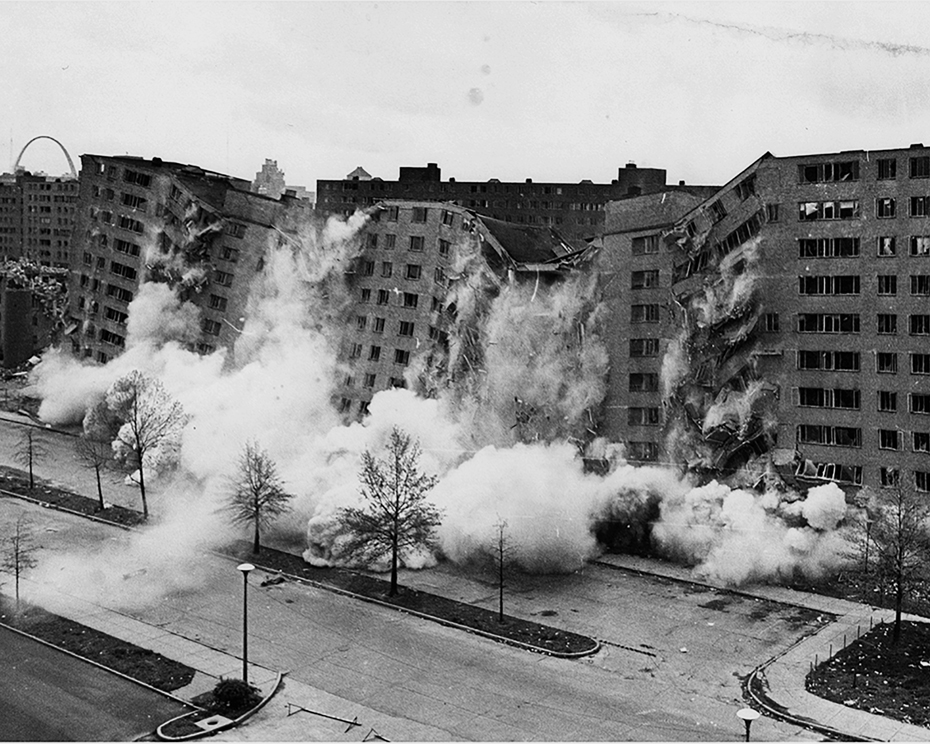
Image: The demolition of a Pruitt-Igoe building, an urban housing project in St. Louis, Missouri, United States, April 1972.