An essay by Cameron Allan McKean asking us to ponder what nature we want to save
Published in
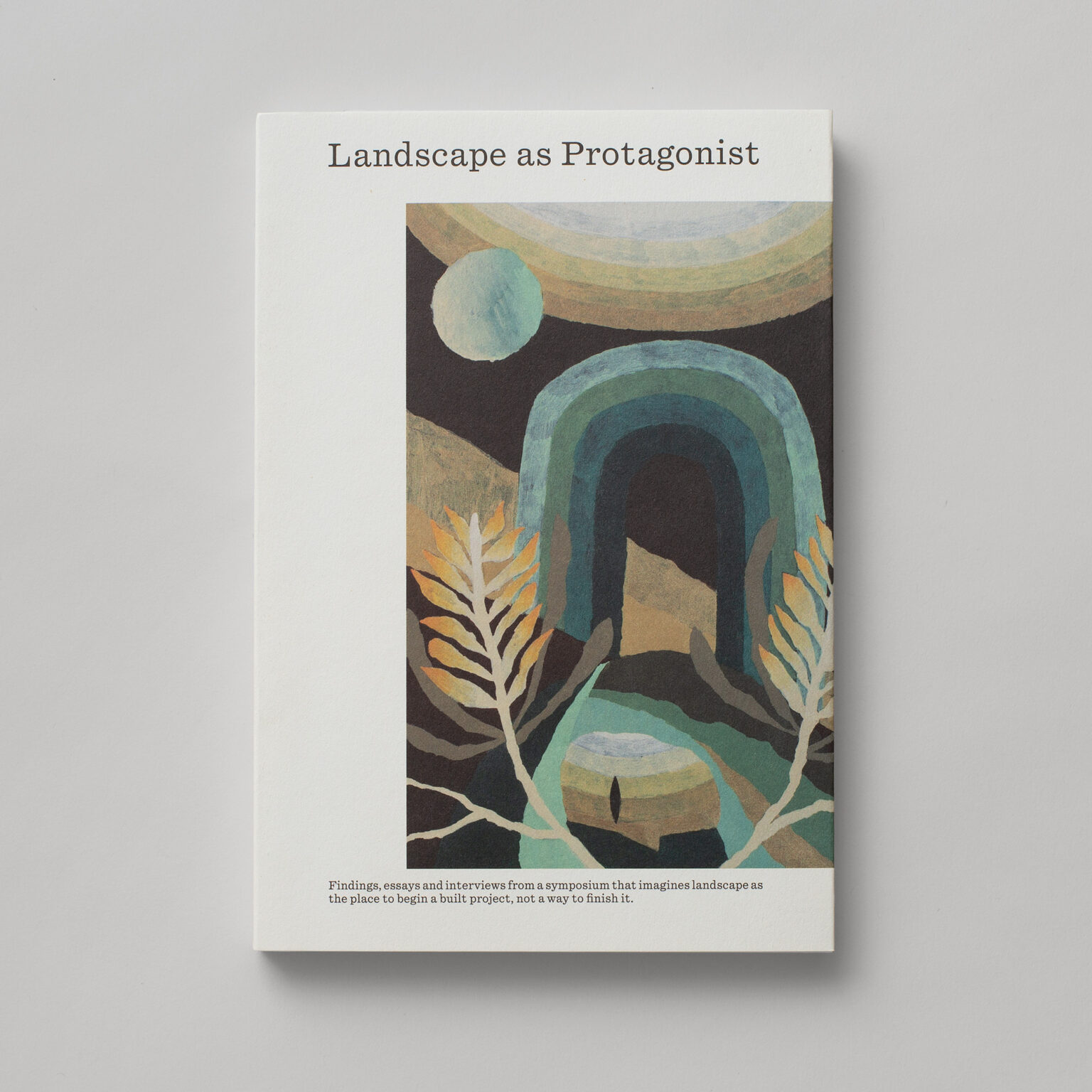
Landscape as Protagonist
Changing the conversation on the role of landscape in built projects.
The world once known disappears from view in a haze of airborne ash, floating petrochemical particles and disintegrating bodies. The altered Earth of late industrialism, which anthropologist Sophie Chao (2020) calls the “world of ashes”, is one in which humans are forced into closer proximity with death: to tread upon, breathe in and ingest the dead. Chao, thinking and walking through a burned-out forest on Australia’s east coast, wonders how this ecological devastation, unprecedented in human history, might reorientate us to the world. As we become “unwitting participants in a macabre, atmospheric communion with more-than-human extinguishings,” she writes, “we must not evade the ashes.” We must “travel with the dead.”
Where do we go? How do we conceptually address this death as once diverse and distinct ecosystems, containing millions or billions of identifiable lives, are congealed into elemental nonliving matter through megafires, rampant disease, marine heatwaves, ocean acidification, floods, proliferating industrial pollution and outright destruction? “The fading afterglow of fire gives way to the obscure trace of its victims,” writes Michael Marder (2014, 162). Life is hard to see. As the light burns out, the blackness appears total. Is this an ending or are our eyes just adjusting to the world of ashes?
Let’s think into this blackness, to think about the dead and the transformation of biological life into elemental non-living matter. How do we orient ourselves as we travel in the dark? Answers might require further orienting questions; rather than just asking how we save nature, we might also ask about the nature of the nature we want to save. Should we be rethinking what is included in our definitions of ‘nature’ and ‘life itself’?
Landscapes without life appear to spread across the planet. But following the horizontal dispersal of death is only one possible means of travelling with the dead. How are our conceptions of nature and life challenged when we open vertical passages into the Earth to spaces where older forms of death and extinction have resided for hundreds of millions of years? Thinking ourselves down follows the trajectory of a cabal of geographers, philosophers and anthropologists – Kathryn Yusoff, Elizabeth Povinelli, Elizabeth Grosz and others – who feel there is something very wrong with the way the subsurface, the realm of the non-living, is understood in the context of our planetary problem. Our conception of Earth-stuff as just an inert, dead resource is challenged by combusted fossils that are actively altering Earth’s climate. This combustion has put more carbon into the atmosphere than there has been for close to a million years: atmospheric fossil matter has surpassed 400 parts per million and, as it rises, planetary cycles are changing. Enabled by certain humans – with specific orientations to the Earth – geological matter acts profoundly in the world, shaping forms of being. How do we, with Yusoff (2013, 779), take seriously “not just our biological (or biopolitical) life, but also our geological (or geopolitical) life and its forms of differentiation”?
To push toward a geological view of ‘life’ – to think from below – is about finding ways of acknowledging how we are always-already entangled with ‘lifeless’ landscapes in our daily lives. Thinking from below is a search for better ways of relating to the not-living, to the undead and never-have-lived, or what Eugene Thacker (2016, 129) calls a “life that becomes not-life, an other-than-life, a becoming–non-living”. Thinking down here is an attempt to see the ways that “life and nonlife breathe in and breathe out” (Povinelli 2016, 44), to see geological power as Elizabeth Grosz does: as the “ontological conditions” under which forces of politics, things and living beings can emerge (Yusoff et al. 2012). Without the non-living, what kind of ‘life’ would be possible?
Enter the ground. Metaphors and analogies start to blur. Opening a passage into the Earth is a descent into a confusing realm “between memory and stratigraphy” (Simonetti 2014, 300). Here we encounter Freudian subconsciousness, the deep-time Earth-memories of Charles Lyell, and the geophilosophising of Deleuze and Guattari. To enter the ground, literally or metaphorically, is to expose ourselves to our spatial imaginary: to create a deep map, a reflexive immersion in “a life that is lived and performed spatially. A cartography of depth. A diving within” (Roberts 2016, 6) – a descent into both subconsciousness and strata.
The air is stuffy. I sink into the stone sofa in my geotherapist’s office.
“Tell me how it started,” a voice says.
It was 1988. I was 6 years old. I remember sitting small in the back seat of our car and looking through the open window. We rushed past the plastic-red needle flowers of blooming pōhutukawa trees that lined the streets near our suburban home in South Auckland, New Zealand. Sounds came through the window, too: people splashing in backyard pools; the engine noise of lawnmowers cutting grass; distant commercial aircraft. I remember thinking about what a teacher had told our class, about the “hole” that had been burned in the ozone layer. I worried about the hole. The sunbeams seemed to stab.
Arriving at my friend’s home, those same sunbeams passed through lace curtains and onto cream-coloured carpet in a brick-lined living room. The television flickered as a worn VHS videocassette began to play. Someone had forgotten to rewind the tape. Sitting alone on the floor, we watched a team of sweaty explorers – holding ropes and torches – entering a volcano. These humans, who seemed so tiny, walked beneath the planet’s surface. We were silent, transfixed.
It was more than a decade before I learned we had watched the 1959 CinemaScope version of Jules Verne’s Journey to the Centre of the Earth. It’s a film that a New York Times critic once described as “really not very striking make-believe” (Crowther 1959), but having grown up without a television, living a very horizontal existence, I was terrified by the vertical horror of descending into an unfamiliar Earth. The ground? Just a cover hiding very big, old and unfamiliar things. What I had thought of as the ground was actually a roof.
I lay in bed that night and thought of what lay under the underneath of my bed. I saw caverns grinding open beneath me, leading to spaces where there were no stabbing sunbeams, no plastic-red needle flowers or grass that needed cutting; only dead stones and voids. And then, vertigo as the passageway opened and deepened. I imagined myself falling into that unthinkable ‘nature’.
In the New York Times review, the critic, Bosley Crowther (1959), noted that one of the good things about the film – perhaps the only good thing – was the way it showed that “quite as important as outer space, is the great mystery of the interior, right here beneath our toes.” The production was otherwise a failure thanks to a “dull” lead who didn’t sing, even once – unforgivable. Why, asked the critic, wouldn’t the producers “let him sing a song, down there in the Earth’s interior”?
In the caverns underneath the ExxonMobil Jurong East facility in Singapore – one of the world’s largest oil refineries – petrochemical liquids are sloshing and gurgling as they pass between spaces. Different, harder sounds are echoing through the Gwalia gold mine near Leonora, where trucks rumble along stone paths on a two-hour drive into the Earth to collect heavy loads of metal. Hundreds of feet below the surface of the North Sea, saturation divers twist and pull on their tools, sending pinging echoes down through metal pipes thrust into the crust. In Australia’s Galilee Basin, spinning excavators crunch and grind deeper and deeper beneath the surface in search of coal seams – traces of old rainforests turned to stone.
In these and other sites, geological nature appears as a stage for a dull musical called ‘Humanity’, in which one animal species – imagining itself atop a great chain of beings – progresses and grows, against all odds, through mastery of its environment to extrude wealth from the ground. Is the Earth really just a stage on which humans imagine themselves as the central characters? Ecological thinkers have been pushing against this conception of our species for the better part of a century. But only more recently, in the blackening of the world of ashes, has this anthropocentrism been loudly critiqued as a driving force of death’s ascendency. The way we think about our relation to the world determines the ways we practise within it; and in the world of ashes, pressure doubles to rework hard conceptual divides between ‘nature’ and ‘culture’, and ‘life’ and ‘non-life’. Reworking is necessary because the bifurcated categories we inherit – where ‘we’ often includes those who instrumentalise or inherit Western ways of being in the world – generate landscapes without life.
What does this mean? It means that how we think about the ground matters. It means that failing to acknowledge the life of geological matter is a primary dilemma. It means that any solution, any technological or scientific ‘fix’ for our planetary problems, will fail unless our thinking changes. We don’t need more narratives of crisis; we need to acknowledge our crisis of narrative. There is a problem with the ways we tell stories about the worlds below.
Look again at the ground. Excavated and extracted, it circulates as building materials, as energy. Through engines, it becomes airborne, molecular. It spirals out, altering temperatures, changing vast biogeochemical cycles, unevenly opening and closing possibilities. The ground is shifting, but it does not shift alone. In its shadow, we face “the radical indifference of geology to human life” (Yusoff 2017, 107), the radical indifference of a strange, changed planet.
In this world of ashes, the habitats of the Holocene become uninhabitable and emptied. Insects disappear, bird populations dwindle, corals bleach, old-growth rainforests burn, and anoxic and toxic zones erase once-vibrant lifeworlds. In this presencing of absence, we are not only faced with individual deaths or the vanishing of a single species, but also with more difficult-to-fathom endings where, as extinction studies scholars have warned, “entire ways and forms of life are at stake” (Rose, Dooren and Chrulew 2017, 5). Humans are not beyond the reach of this ascendent death; our form of life is implicated, too. Deep in stone, the possibility of human extinction is written by the fossils of our ancestors who died due to prehistoric climate changes. These mineral bones point toward a future where we return to the Earth. Our species: just another fossil to come, to be locked in strata.
Unmaking our crystallising future is often understood as a process of slowing or preventing the return of living ‘nature’ to the non-living strata of the Earth. This process is framed in terms of ‘rescuing’ nature, or ‘saving’ vast multispecies assemblages – rivers, rainforests, reefs – and the charismatic species who populate them – Texas wild rice, Bornean orangutans, hawksbill turtles. ‘Saving’ means preserving, restoring, repopulating and – at the edge of the impossible – bringing certain life forms back from the dead.
But as thinkers in the environmental humanities remind us, so-called life and nature are becoming ‘so-called’ for a reason. “When people rally to save ‘the environment’,” writes multispecies ethnographer Eben Kirksey (2015, 37), “perhaps one should always follow Donna Haraway and ask, ‘What counts as nature, for whom, and at what costs?’” Haraway’s questions, which she asked in 1997, inspired by British anthropologist Marilyn Strathern, help untangle what we’re really talking about when we claim to talk about ‘nature’. What matters and how does it come to matter? Her questions nest inside any attempt to claim nature as pristine, distinct or easily locatable. They push us to query the depth of relations between species and ecology, to query why we imagine nature to exist more in some places than others – and to query why non-living matter is often forgotten or excluded in demands to save Earth.
These are all questions about how our conceptions of nature and life are spatialised. At some level they are all ‘where’ questions. How do we go deeper, to consider life not only as the gooey, respirating, vibrating matter of a mutating biosphere but also as an equally forceful geosphere beneath, filled with mineral agglomerations, crystal lattices, petroleum lakes, lithium veins and fossil beings?
An emerging world dominated by lifeless landscapes is one immobilising vision of the future projected by climate crises; but viewing a future world, somewhere out there, as uninhabitable obscures the layers of non-life upon which modernity is contingent in the present. Non-life structures not only modern cities but also modern subjects. “[The] fires of combustion that underpin late capitalism – the energy, the heat of transformation, and the compulsive materialism of the Carboniferous – are irreducibly part of what it is to be a subject of late capitalism” (Yusoff 2013, 784). And the non-living fuel that feeds that fire not only structures modern cities and formats fossil subjectivities, but is also itself a political subject. Povinelli (2016, 58), thinking towards the edge of what she calls the “carbon imaginary”, asks: “Are the subjects of politics now not merely humans and other forms of living labor and capital – corporations, miners, politicians, and Indigenous custodians, protected plant and animal species – but also the undead and never-have-lived?” By “subjects,” Povinelli does not mean ‘topics’; she means active members, geological members, of a nation state: forms of not-life granted rights and possibilities like those of the living.
There may be other questions we should be asking. What does a different relationship to the ground look like? What kinds of ethical dilemmas emerge down here? What does it mean to be responsible in this context? How are responsibilities to the ‘past’ and ‘future’ taking shape as the environment is increasingly figured as a necropolis and a lifeless world-to-come?
To begin the difficult task of answering these questions – to travel with the dead – is a process of learning to think from below. Thinking the world of ashes from below calls for orientations that consider living species in the here and now, and also non-living matter and forces at more-than-human scales of space and time. As lifeworlds are halted and altered in the long shadow of climate change, we must take seriously the task of making “natures in the plural (White et al. 2016, 116) – allowing life on Earth to exist in multiple gradients and guises that go beyond conceptions of nature as only biological and fleshy. How do we travel with the dead? We can no longer imagine ‘nature’ as pristine, separate or singular. The world of ashes burns holes in our ideas of ‘nature’. These lacunae call out for new ways of moving and knowing, as ‘life itself’ is sucked down into the Earth.
Don’t resist. Fall into an unthinkable ‘nature’. Follow multispecies kin and non-living entities into these openings, into the grand conveyors that draw life in and out of the planet. Is a different orientation to the world possible down here – one in which Earth is not merely a mute resource, or a stage? Far below, ‘nature’ is not textured by the green and vegetal or the evolving and mutating, but by that which underwrites life as we know it: the mineral, crystal, fossil, geological. Its energy transfers itself through the Earth, through the bacterial, the vegetal, and the animal.
I’m thinking of songs sung, down there in the Earth’s interior. In the world of ashes we must learn to sing different songs but also learn to listen to the longer, older songs of non-living matter. How do we listen to the geological songs already sung through us? How might we open up to these geological songs, to think with dead pasts, with dead futures, deaths that have been and deaths to come, with lives that become not-life, with the other-than-living, the becoming-non-living, the long dead, the un-living, the unborn-but-someday-dead, the forgotten dead, and never-have-lived? Life is here, too.
This essay was originally published in Landscape as Protagonist, a book of discussions and findings from the symposium of the same name, held as part of Melbourne Design Week. It features interviews with Thomas Doxiadis, Marjetica Potrč and Dan Pearson and essays by Bruce Pascoe, Tanya Patrick, Katherine Sundermann, and Andrew Reynolds. Illustrations by Al Stark. A Molonglo publication, edited by Stéph Donse. Available here.
Cameron Allan McKean attended the symposium where he challenged us during group discussions with bigger questions than we were expecting. What is nature? Who defines it? Who decides what it’s going to look like and do? We asked him to write an essay to help us understand the importance of thinking through these questions when it comes to making decisions about ‘nature’; and inevitably, our relationship with nature.
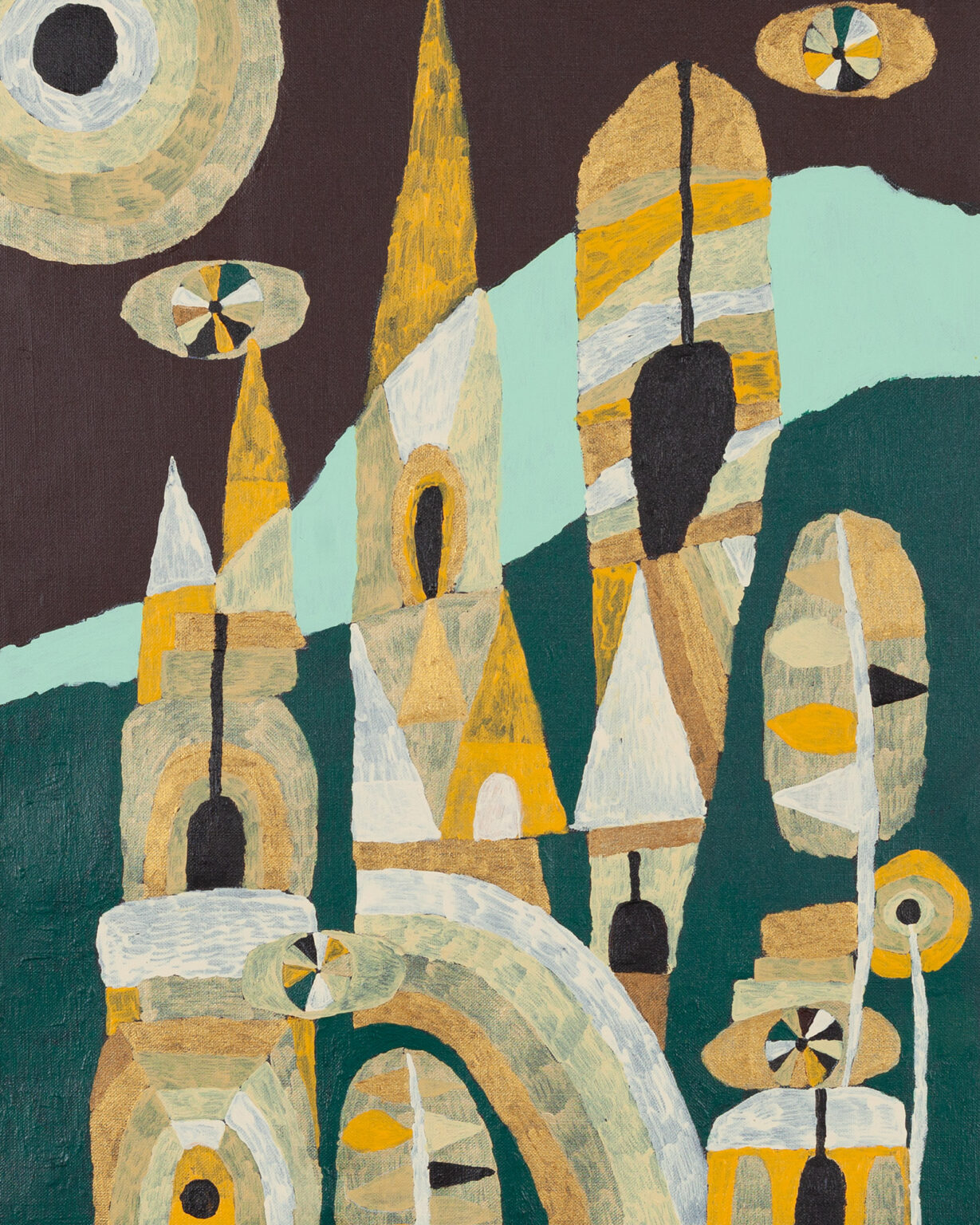
Al Stark, 'What Do We Do When We Stop Pretending', 2019.
References
Chao, Sophie. 2020. “Chao, Sophie. A World Of Ashes.” Sydney Environment Institute (blog). Accessed February 14, 2020. http://sydney.edu.au/environment-institute/blog/a-world-of-ashes/.
Chrulew, Matthew, Deborah Bird Rose, and Thom Van Dooren. 2017. Extinction Studies. 1st ed. New York: Columbia University Press, 2017.
Crowther, Bosley. 1959. “‘Journey To The Center Of The Earth’; Verne Fable Opens At The Paramount.” The New York Times, 17 December. Accessed February 14, 2020. https://www.nytimes.com/1959/12/17/archives/journey-to-the-center-of-the-earth-verne-fable-opens-at-the.html.
Kirksey, Eben. 2015. Emergent Ecologies. Durham: Duke University Press Books.
Marder, Michael. 2014. Pyropolitics: When the World Is Ablaze. London: Rowman & Littlefield International.
Povinelli, Elizabeth A. 2016. Geontologies: A Requiem to Late Liberalism. Durham, North Carolina: Duke University Press.
Roberts, Les. 2016. “Deep Mapping and Spatial Anthropology.” Humanities 5(1), 5; https://doi.org/10.3390/h5010005.
Simonetti, Cristián. 2014. “With the Past Under Your Feet: on the Development of Time Concepts in Archaeology.” Anuário Antropológico II: 283-313. doi:10.4000/aa.1306.
Thacker, Eugene. “Biophilosophy for the 21st Century.” In Resisting Biopolitics: Philosophical, Political, and Performative Strategies, edited by S. E. Wilmer and Audronė Žukauskaitė, 123 – 134. New York: Routledge, 2016.
White, Damian, Alan Rudy, and Brian Gareau. 2015. Environments, Natures and Social Theory: Towards a Critical Hybridity. 1st ed. London New York: Palgrave.
Yusoff, Kathryn. 2013. “Geologic Life: Prehistory, Climate, Futures in the Anthropocene.” Environment and Planning D: Society and Space 31, no. 5 (1 October): 779-95. https://doi.org/10.1068/d11512.
Yusoff, Kathryn. 2017. “Geosocial Strata.” Theory, Culture & Society 34, no. 2-3 (1 May): 105-27. https://doi.org/10.1177/0263276416688543.
Yusoff, Kathryn, Elizabeth Grosz, Nigel Clark, Arun Saldanha, Kathryn Yusoff, Catherine Nash, and Elizabeth Grosz. 2012. “Geopower: A Panel on Elizabeth Grosz’s Chaos, Territory, Art: Deleuze and the Framing of the Earth.” Environment and Planning D: Society and Space 30, no. 6 (1 December): 971-88. https://doi.org/10.1068/d3006pan.